


Posting a guide on how to use Solio was a popular request from you guys last season, even before I struck a partnership deal with this amazing bunch:

Technically, this makes the article an #ad.
However, I would never recommend anything I don’t use myself, and regular readers know that I used Solio throughout the entire last season before seeing a single penny from it.
💡 Also, I believe that using event data and solvers effectively will improve the quality of your decisions, make the game more enjoyable, and give you a substantial edge on the field.
Alright. Let’s say you’re trying the Solio Analytics tool for the first time.
You log in, go to the decision tree, create a new branch, and click “Optimise” to see what the solver suggests for the basic 5 GW horizon (you can plan up to 19 in the PRO version).
And voilà:
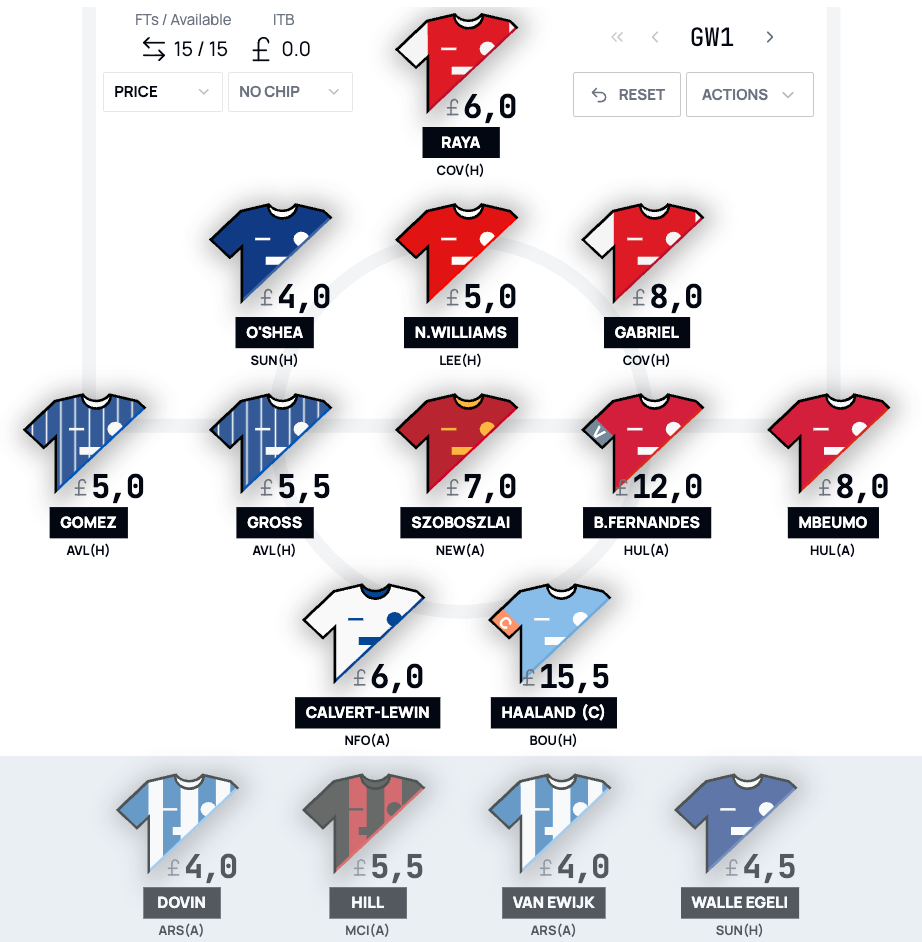
Now you’re sitting in front of the screen, wondering whether this was really it, just like that one night when you were 16, walking Andrea home from dancing school, and… um, never mind.
In fact, it only gets better from now on.
Using tools to make better decisions is normal
Before getting into exactly how solvers can make you a better FPL manager, let me start with the following:
It’s the year 2026, and a vocal group of people still think that optimisation tools:
make the game a worse experience for all involved
play the game for you
As for the first point, it vastly exceeds the scope of this article, so just briefly – solvers don’t make the game worse, just different. FPL evolves, whether you like it or not. This evolution is perfectly normal.
In 2009, you could create a Facebook group called “I like sunsets on the beach” and rack up 50,000 followers in two weeks. Playing online poker tournaments around that time was effectively printing money. Not that long ago, you could become a multimillionaire by trading meme coins.
Now, there are teenagers who have become obscenely rich by hopping on the AI trend super early. Adaptation is the skill that moves the needle, both in FPL and in life. It’s up to you whether to spend your time constantly whining about stuff or accept the rules of the game.
Knowing my readers, I know which group you belong to.


In fact, there are two important skills. First, adaptability. Second, high agency, aka making things happen yourself rather than waiting for someone else to do it for you.
Solio and other solvers are just tools.
YOU still play the game.
YOU make decisions.
Once upon a time, managers used pen and paper for this (some still do!). Some prefer Excel files or old-fashioned Windows Notepad. You should see mine from my “professional” real-money DFS career. These text files, in which I analysed players and brainstormed strategies for weighting my teams, were enormous.
Solio is like a hammer.
A really nice hammer.
It’s forged from high-quality steel, so the structure is solid and less prone to deforming on impact. It has a nice, durable handle. The weight is perfectly distributed, making the swing more controlled. The grip is better and absorbs vibrations, so you can hammer even more nails without your hand hurting.
But the hammer doesn’t suddenly start levitating in the air and build a nice doghouse.
Finding your ideal chip strategy
We’re just a few days away from Gameweek 1.
The second batch of chips, introduced last season, created a compelling use case for Solio.
I used it extensively while writing the chip strategy guide:

Part of my screen looked like this:
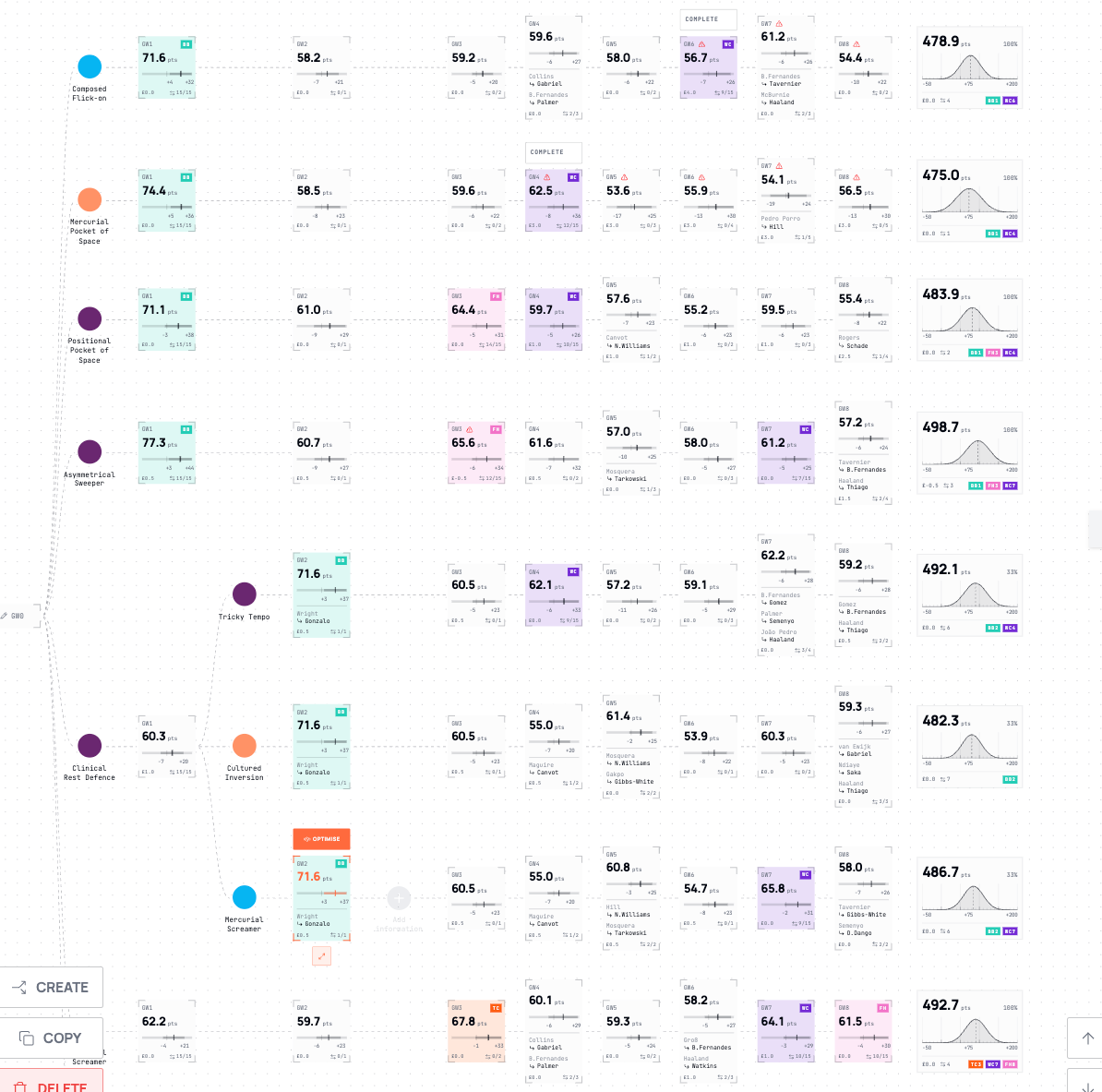
What you’re looking at now is called a decision tree.
Think of it as the central hub where you can compare and plan your transfer routes to see what best suits your managerial style and aligns with player and team analysis.
Why a decision tree?
Well, because each decision you make in a specific gameweek has an implication for future ones. (duh)
💡 Many managers place heavy emphasis on whether the transfer you’re making now helps you over the weekend. That’s layer one.
The second is whether the player has a favourable run of fixtures and is performing well.
But that one decision triggers a cascade of future decisions within your team.
You need to keep answering questions such as:
Would this transfer help me get the most points over a 10-Gameweek horizon (until I wildcard, for example), or would I earn more points in the long term if I save two more FTs and make a more elaborate 3-way move in two weeks?
Also, one injury can derail the whole plan. Think about how often something unexpected happens during the season, and how often you change your approach even within a single Gameweek of FPL.
Fantasy Premier League, like poker, sports betting, investing, or just life, is a game of incomplete information. A skill game with an element of luck, if you want.
Solio uses stochastic programming for FPL, a method that enables robust planning under those various uncertainties.
It makes planning around chip strategies straightforward. The fact is, the “best” chip strategy for the first half of the season doesn’t exist. If you come across someone who tries to tell you the opposite, they’re a fraud. You wouldn’t believe how many things in life you can calculate. This isn’t one of them, though.
There are several ways to be successful or reach your desired destination, be it a mini-league win, top 100k, top 10k, or whatever aspirations you might have.
💡 In Solio, you can put all chip strategies you find viable alongside each other, try to guess which transfers you’ll make along the way based on the current information, and see what suits you best.
Often, you find that many strategies are fairly close in EV (expected value/expected points), but some are safer or more convenient from a meta-game perspective:
your risk tolerance
your willingness to diverge from the template
your psychological comfort with a plan
… et cetera.
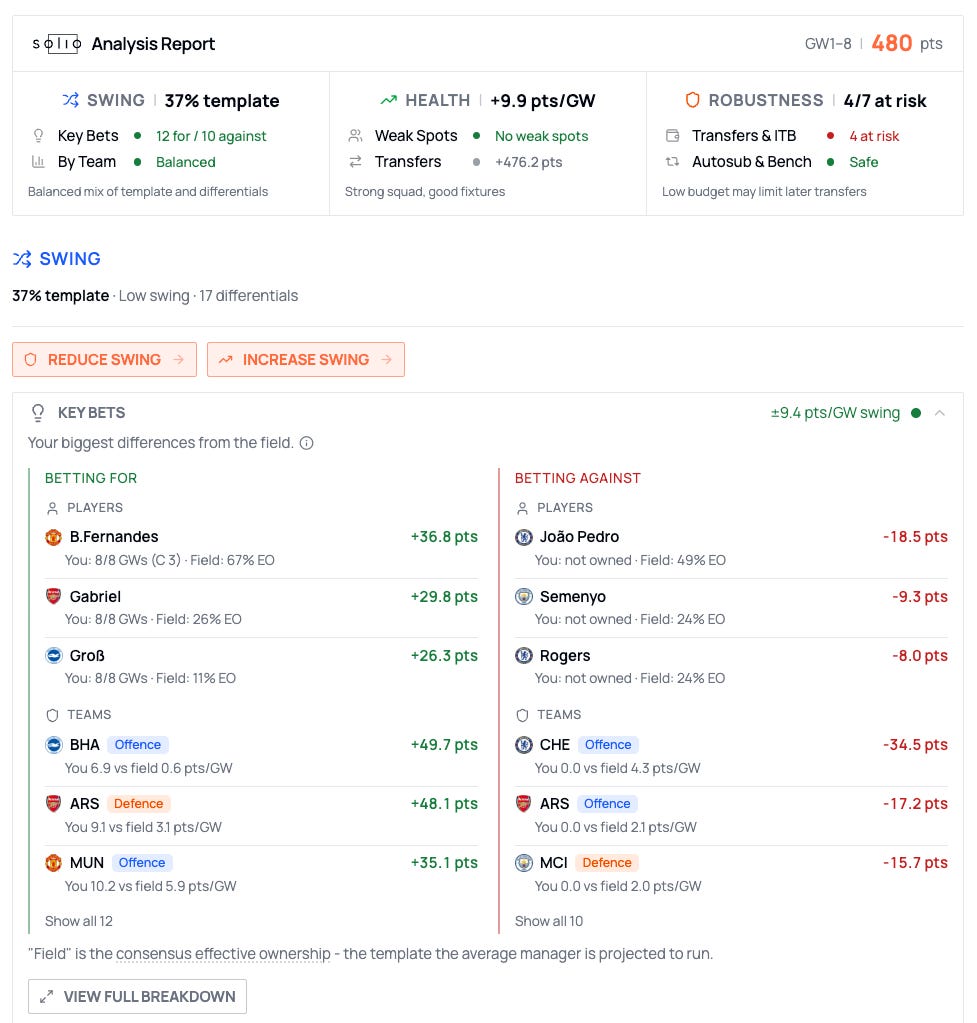
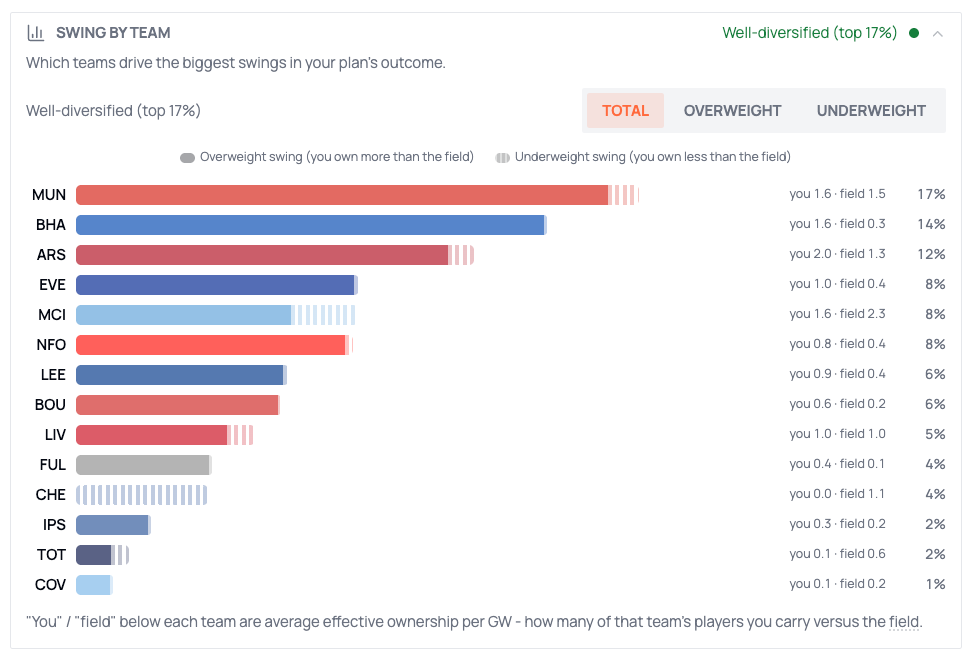
Before this season, they introduced the new “Analysis” tab, which helps you analyse the risk your squad carries. You can see your biggest rank threats and whether your team is balanced or overexposed to certain teams.
At the same time, it might not be a mistake but part of your managerial style.
The tool doesn’t tell you what to do but simply gives you more information:
9 ways Solio could help you become a better manager
Exploring different scenarios can give you a better grasp of several key concepts we regularly discuss here on Data Dribble.
Let’s list some:
1️⃣ The most obvious one.
Optimisation tools help you see what’s possible and get a good feel for your own team and the current FPL landscape.
There’s no substitute for this.
2️⃣ One thing that might surprise you the first time you use it is how quite different transfer routes and strategies can lead to similar EV results.
Some plans may differ by as little as 1 or 2 EV* across the large sample of GWs. Not only does this mean there are more ways to play the game, as I mentioned above, both chip-strategy-wise and picks-wise, but it also makes you realise one crucial thing:
💡 Some decisions are so close that you don’t need to agonise over them, but rather spend the time on:
a) more important decisions
b) improving decision-making in generalAnalysing picks is just part of the game.
You also need to consider meta-game factors such as:
managing risk with effective ownership (covering major threats or countering them in certain spots)
distinguishing between players’ ceilings and floors – not just total EV, but also the distribution
valuing free transfers
valuing more information
understanding teams’ weaknesses and playing style
analysing what changes when key players are injured or suspended
ability to interpret why your players are not scoring points (and vice versa)
mindset factors such as managing tilt (because when on tilt, you’re making worse decisions)
improving and evaluating your decision-making frameworks*
… and much more
*Decision-making frameworks are mental tools that make your decision-making process easier and your decisions more consistent. For example, in GWs 1-19, if two players have the same EV, I will always captain the one with higher effective ownership. Or, if they have the same EV, I will always captain the more expensive player. You get the idea.
It’s not just about hitting the solve button – I don’t think you can ever solve the game. FPL solvers are very different from poker solvers, for example.
3️⃣ It helps you understand that free transfers are the most precious thing you have – seeing the whole route can stop you from making a poor one.
For example, you instantly see that you won’t gain much EV from doing it, whereas saving it might allow you to accumulate much more later by:
fixing a problem
attacking the real upside
Extremely valuable.
4️⃣ I already noted this earlier.
It also highlights that even a small change this week can have a huge impact down the line.
The close decision between player A, player B, and player C can become a no-brainer when you see all the future implications.
You pick player A for a slightly higher EV, but you won’t be able to buy player D next week, which can trigger a chain of events that gets you into real trouble. You can prevent getting into those tricky spots long before they happen.
In other words, it teaches you not to think about the move in isolation. You consider 3 players, then you see the whole path, and one option now emerges as much better than the other two.
Great FPL managers will not consider more options than average managers, they will just consider better ones.
5️⃣ You can react swiftly to things.
Again, injuries and suspensions happen all the time.
Also, players suddenly stopping performing happens all the time.
Players are just people, and I have countless stories from my career in professional football where the loss of “form” has nothing to do with football and everything to do with personal stuff. ❗
6️⃣ It’s a powerful idea generator.
Sometimes you think you’ve explored every possible solution, but the truth is, Solio’s computing power is greater than your brain’s.
You might have missed something. It happens to all of us. Trying to solve with different rules and constraints might reveal something you wouldn’t even consider.
7️⃣ There are also situations where you’re unsure and simply want to test your ideas against solvers.
Alternatively, if you’re advanced enough, you can reverse-engineer why solvers consider it a good solution.
All models have biases, and you can spend time understanding how they think to exploit them.
8️⃣ It helps you understand variance (an element of luck).
It’s a key to playing the game.
The classic decision quality vs the outcome discussion.
You know, I discuss this regularly on Data Dribble – football is a low-scoring game with few shots per match, so luck plays a major role in small sample sizes. You need a proper sample from the current season, or a large sample of historical seasons, for skill to prevail.
A poor decision can have a good outcome.
A great decision can have a poor outcome.
But directly seeing evidence that you’re making an informed, data-supported decision can help you immensely, mentally.
At a football company where I worked as the head of the analytical department, we placed the utmost importance on the chain of events leading up to the shot to improve teams’ decision-making in the transfer market. Shots alone aren’t enough.
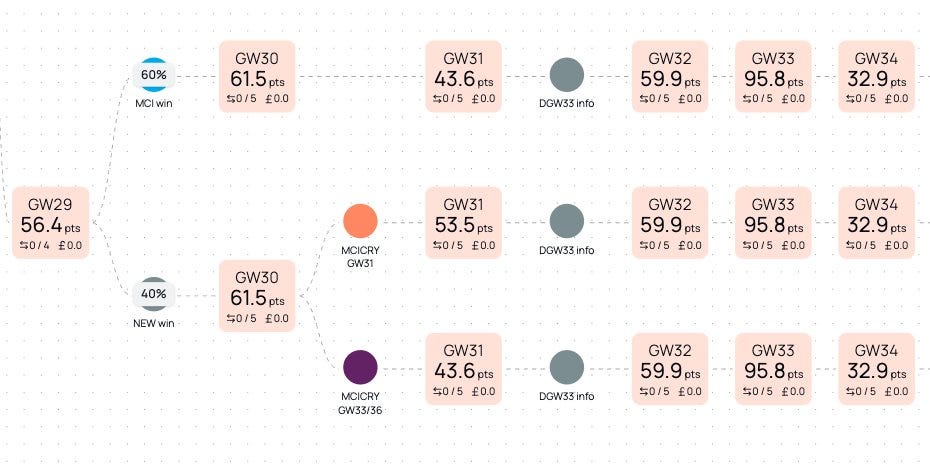
9️⃣ Optimisation tools enable planning that fully captures “what-if” thinking in a meaningful way.
The chip strategy in the second half of the season is a prime example of this.
You can develop a concrete strategy for each uncertain scenario and identify those that allow you to maximise both points and flexibility in the future.
It also allows you to think in probabilities, which is extremely important.
See, I just came up with 9 ideas, and I could keep going.
I understand you might feel a bit overwhelmed now, but you don’t have to do everything at once.
That’s the beauty of FPL.
You can play it for 30 minutes a week or spend 30 hours on it. Find what suits you best. Solio allows you to do both. You’re the one who decides how much time and emotional bandwidth the game should take from you.
If you don’t agree with something, customise it
This one is important to me.
You can add constraints and bring your own beliefs.
A constraint basically means locking or banning certain players, either for a specific Gameweek or for the whole horizon, before hitting “Optimise”.
If you want to start the season without Erling Haaland and not consider him until Gameweek 7, you can do so easily.

You can also pick a preset based on your risk tolerance, ranging from “I just love differentials” to “I’ll play it safe, and always want to have FTs to solve problems”.
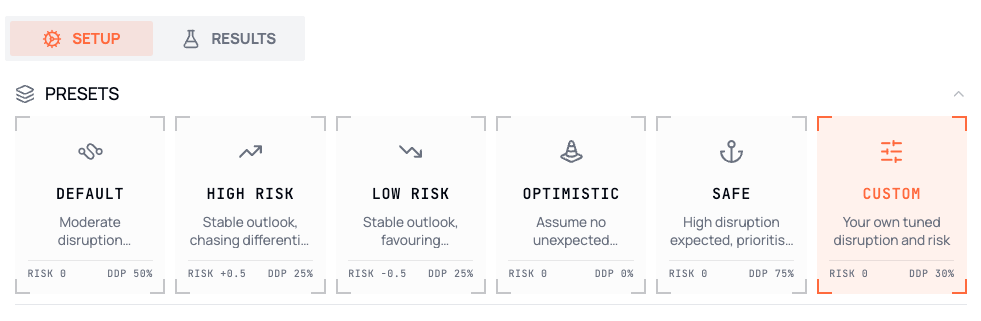
You can do a lot of customisation.
You know that I put a lot of emphasis on detailed match-up analysis during the season, constantly looking for an edge over the field and models.
For me, during the season there are often stretches when I believe a player is a better pick for a substantial run, as those matchups suit him more than the model and markets predict.
Or there is an injury, a suspension, or some other change in the team’s dynamics.
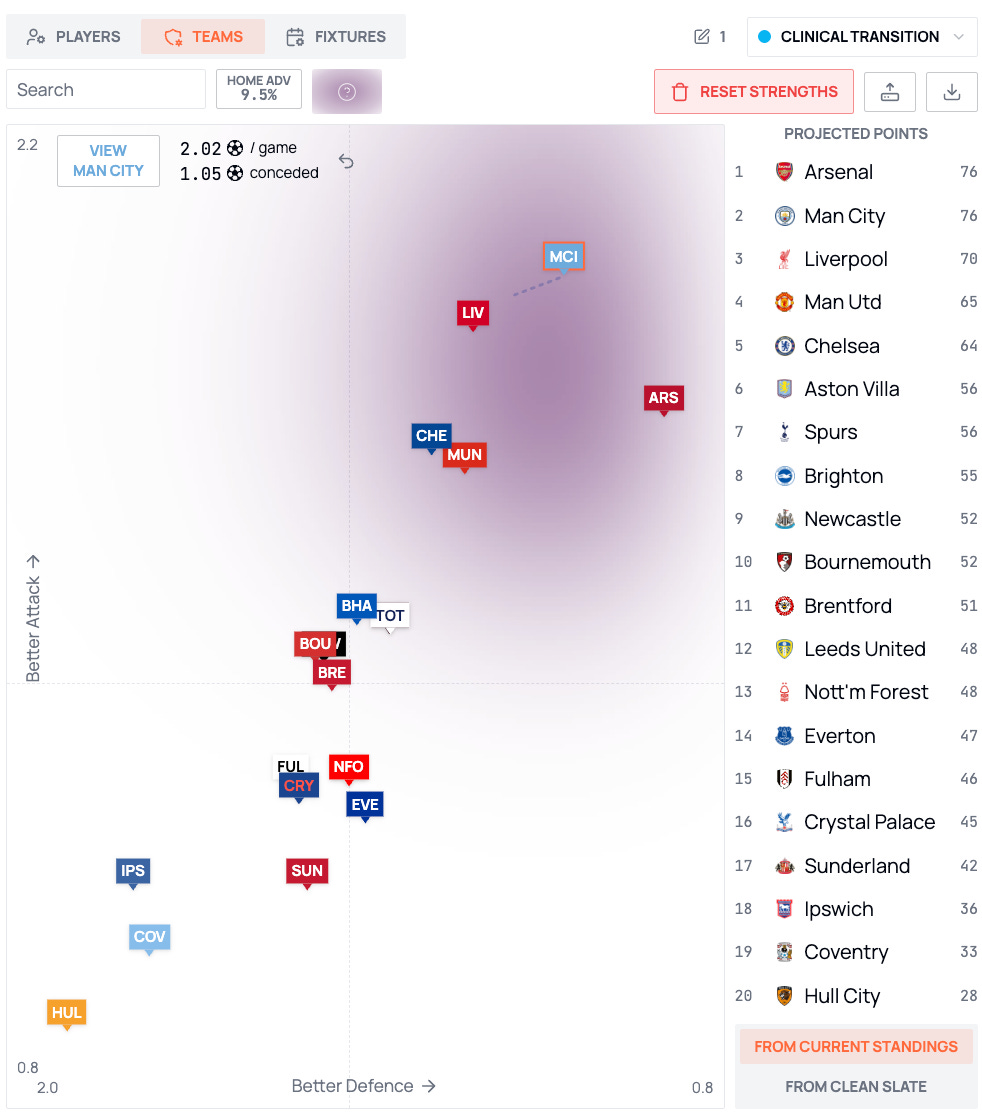
I can then edit:
predicted minutes
goals
assists
DEFCONs
team defensive and attacking strengths
… or penalty share.
Which is amazing.
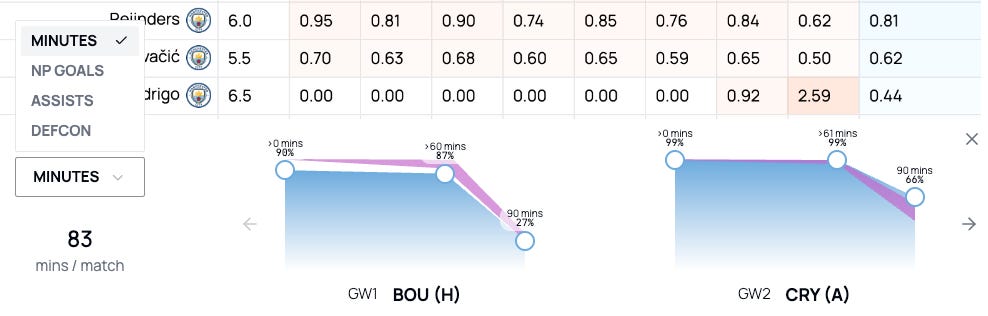
Sometimes, you want to do just one.
Sometimes you do both: you think City’s attacking strength improves, AND Antoine Semenyo has more favourable match-ups than FDRs suggest, so you adjust City’s goals per game and bump up his share of the team’s goals.
❗ This is a broader overview of how FPL optimisation tools can make your life easier and help you become a better manager in the process.
During the season, the regular Though Process series will run again.
Its goal is to discuss and apply various fantasy concepts, as well as how to use data analytics properly. There, I’ll show you some more specific use cases.
That’s all for today.
Next up – the second part of the complete guide to the 26/27 Premier League season, followed by an article on creating a Gameweek 1 draft.
See you very soon!
The play by heart and head v play by data is something I’m torn on.
My heart and head said no to Joao Pedro. But his EO is so high the analysis tab shows he would really kill anyone not holding him in the first 5 game weeks (potentially). Do I want to risk that? Stats and head say no.
But I’ve pulled him in.
Hi Filip
Is Custom Setup only available on the most expensive plan?
Thanks