



❗ There’s some theory to cover first. I don’t recommend skipping it, but if you’re already proficient in game theory and the current Premier League landscape, and you’re here only for drafts and specific chip strategies, keep scrolling until you reach the first draft.
It’s no secret that I’m not exactly a fan of the first set of chips FPL introduced last season.
Football is a low-scoring game with a substantial element of luck, and that directly translates into all sorts of fantasy games. Chips in Gameweeks 1-19 introduce another layer of variance and distract you from the basic principles of pure player, team and fixture analysis. They superficially force action where it’s unnecessary.
But it’s there.
We can do nothing about it but adapt.
🍕 What’s on today’s menu?
🔸 Uncertainty is the season’s theme. What’s the context?
🔸 Why is the Bench Boost 1 or 2 the sexy topic?
🔸 Analysing different BB1 and BB2 chip strategies
🔸 Haaland vs no-Haaland
🔸 The old-school strategy for using Bench Boost (and other chips)
🔸 Why the Free Hit chip isn’t what you think
🔸 3 ways to use Free Hit
🔸 The ultimate chip strategy that starts deploying chips in Gameweek 7
… and more.
To start with, the perfect GWs 1-19 chip strategy doesn’t exist.
It’s unsolvable during pre-season (it’s more about game theory), simply because there’s so much incomplete information and moving parts*. That’s the risk of committing yourself early: it dictates your play while you’re still sharpening your opinions.
*It’s not deployed in isolation, but you a) manipulate the picks, b) it can reflect your playstyle, and c) there are moving parts like transfers, injuries, new information, etc.
Ultimately, FPL is a game of numbers – whether you like it or not – decision-making, and tilt avoidance. It’s about making sound, small decisions week after week that compound. These are more important than assessing which chip strategy is “the best one”, as EV is often much closer than you think.
There are always trade-offs.
Also, arguments like:
it worked last year
it worked for someone who did well
… aren’t really helpful. It’s not a signal.
Some people with no-Haaland drafts for the whole season finished top 50k, some top 1M. Some people playing WC4 finished top 1k, some in millions.
Also, it’s a different season from last year. For starters, there’s no £4m starting goalkeeper. The fixtures are different, and the landscape has changed.
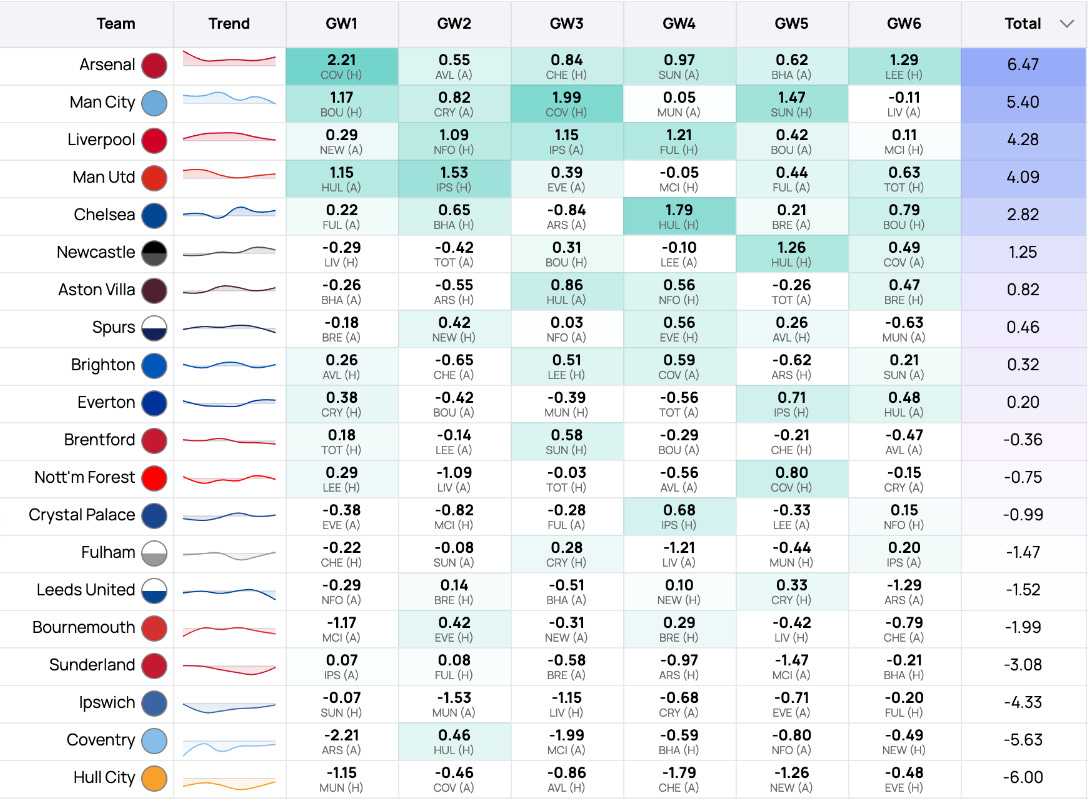
Fixture difficulty rating on Solio ranked by predicted goal difference
Speaking of the landscape, it’s critical to understand it properly.
And there are levels of detail to consider:
1️⃣ Helicopter view
There’s so much uncertainty at the moment:
10 clubs will start the season with a new manager. It’s something you can partially assess, which is what I’m trying to do with my deep dives – it’s an informed guess based on historical data and the current context. However, it’s still a guess.
There are 3 promoted sides, each of which is going through the classic Premier League rebuild.
Several key players had long, gruelling World Cup-affected seasons and will be eased into the new campaign slowly, which may mean late arrivals or managed xMins. That’s a big deal.
The transfer window will close after Gameweek 2.
There’s a 3-week international break after Gameweek 5. We’ve never had a break this long. How will managers respond to that? Will they adjust heavily based on what they’ve seen in the first five gameweeks?
Plus: another IB after Gameweek 10 (just two weeks long).
Plus: the congested Christmas period begins in Gameweek 12.
2️⃣ Submarine view
This is where you go into more detail:
Your interpretation of fixture difficulty
Assessing how transfers affect team strength (and dynamics)
Assessing newly promoted teams
When two teams clash, what will the match-up specifics be (positional weaknesses, fast transitions, ability to break low blocks, set-piece attacking/defending)?
How do tactics influence how midfielders and defenders earn DEFCONs?
There are 4 chips (duh): Bench Boost, Wildcard, Free Hit, and Triple captain.
Most of the pre-season discussion revolves around the Bench Boost, so let’s look at that first.
Early Bench Boost: What’s the appeal?
Early Bench Boost is like Taylor Swift.
On the surface, it’s extremely popular, but a few days ago, you didn’t personally know anyone who was into that. However, if you stop for a minute and think about it, you realise it’s actually quite nice.
It’s a strategy that’s certainly gaining traction among engaged managers this pre-season.
💡 The value proposition is clear: by using the chip in Gameweek 1 or 2, you don’t have to carry it with you and let it dictate your strategy over the long run of fixtures.
You know, you have a BB planned, then an injury comes, and you either have to solve it, which isn’t always possible that week, or postpone it for several GWs. Only to arrive in another viable GW, where it happens again…
You’re losing a ton of EV/xPoints in the process, just constantly solving problems.
Ugh.
Also, if you pair early BB with an early(ish) wildcard, it allows you to build a bank of free transfers and still utilise some early-season information (though you’ll still miss some).
❗ It’s not as if playing early BB makes things a walk in the park.
It dictates your strategy too, just in a different way.
If you are reluctant to play early WC, you might be using your free transfers, the most precious thing you have in FPL, to start moving funds back to your starting XI.
And if you counter this with an early wildcard, the BB, once again, dictates how you’ll use your strongest chip.

Wildcarding early allows you to redistribute funds back to your starting XI, but how appealing is using a wildcard just to change a structure you dislike at a stage of the season when we still have less-than-ideal information? I’ll let you be the judge. Several approaches can work.
Early BB becomes more appealing if:
having a bench full of players who can perform in most weeks suits your managerial style
and your strength is identifying strong match-ups to rotate those players properly
Plus, if you’re mentally prepared to bench a lot of points in some weeks. Try to limit things that can mess with your head when playing FPL.
One other caveat, as I noted earlier, is that you’re building the BB with limited pre-season information.
You ideally want cheap players with favourable fixtures to extract proper value. For BB1, it’s Forest vs Leeds at home or Ipswich vs Sunderland at home, though I’m not 100% sure about quality of those match-ups at this point. For GW2, it’s Coventry vs Hull and Sunderland vs Fulham.
Okay, let’s stop theorising and look at some real-life examples, because there are many ways to manipulate early Bench Boost using different structures and plans.
Bench Boost 1, WC 6-8, FH & TC whenever
Even if you want to keep both Erling Haaland and Bruno Fernandes, you can still build a pretty good draft:
*Note that this article is not a guide to specific picks – its purpose is to show different structures and solutions. We’re not locking ourselves into specific drafts just yet.
I used the Solio Analytics tool throughout this article. You can spend a nice afternoon (or two) going through all the scenarios.
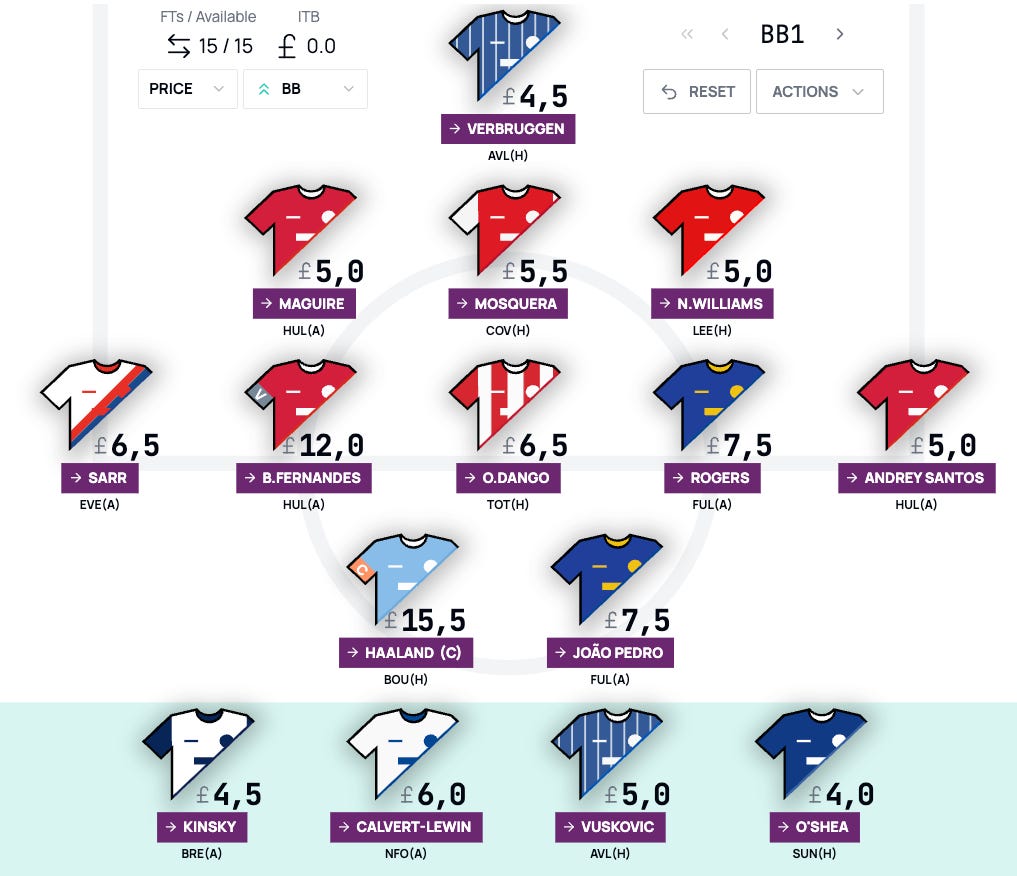
The earlier you wildcard post-IB, the fewer weeks you’re forced to play with a suboptimal bench. The problem is that, at least for me, I’d ideally want to wildcard after the IB and see a few weeks of info after the break (though I’m okay with GW6 too).
The reason is that I wonder whether managers use that long window to fix things they didn’t like during GWs 1-5. Imagine you wildcard, thinking a certain team uses a specific tactical setup and roles, only to find that setup has changed.
Yes, you likely have some FTs saved, but it’s still fixing problems. In an ideal world, you want to position yourself for more EV-hunting, less problem-fixing.
Anyway, it’s pretty doable to use just 2-3 FTs and arrive in the WC8 window with a nice bank of free transfers.
1️⃣ The longer you wait to wildcard, the higher the opportunity cost of the stacked bench (or the cost of making transfers to reduce it).
2️⃣ The sooner you wildcard, the higher the opportunity cost of having less information and potentially forcing transfers later.
If you’re okay with wildcarding in Gameweek 6, executing it should be a piece of cake. For example:
GW2, GW3: roll
GW4: Bruno Fernandes –> Cole Palmer, DEF → Gabriel
GW5: roll
GW6: wildcard
GW7: 3 free transfers
Of course, the cheaper the BB1 bench, the longer you can postpone the WC, but there needs to be a balance. I’d focus mainly on having very safe players with good xMins in GW1.
I quite like this strategy if you want to Bench Boost in GW1 – it strikes a nice balance between having some information and not carrying too much money on the bench for too long.
Bench Boost 1, WC4, FH & TC whenever
It could look something like this: