



In the past three weekly newsletters, I discussed premium FPL picks: Bruno Fernandes (£11.7m), Bukayo Saka (£9.5m), and Cole Palmer (£9.8m).
The Data Dribble community knows one of my favourite topics this week is Liverpool (and their number nine…). I already did a fun analysis at the team and matchup levels, and I plan to delve into individual players later this week.
But to keep with the recent theme, let’s talk about Alexander Isak (£9.1m) ahead of time.
Did we forget how good he is?
My message when debating the FWD picks for upcoming months was:
Be open-minded about the Swede.
He doesn’t need to be your preferred forward pick. He might even not be the best pick for your specific team because:
The squad is better suited to a different structure
He restricts your ability to execute future plans
He limits your flexibility…
… doesn’t rotate well…
… or doesn’t fit your playing style
Also, there’s currently an abundance of cheap FWD picks, and there’s still so much value in João Pedro when he’s fit
There might be many reasons, often several at once.
But he could potentially disrupt the current template and change the “premium” landscape.
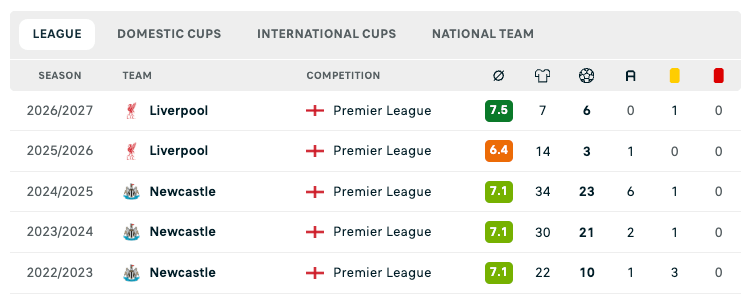
Last season, injuries limited him to just 700 minutes. Now he’s back in the conversation, and it’s a timely reminder of his quality. Frankly, I had almost forgotten how good he was at Newcastle.
The other day, I looked at some data on prime Harry Kane and wondered whether a Premier League striker of that complexity will ever emerge in the near future.
Alexander Isak is not Harry Kane.
But he’s pretty damn good.
This season, João Pedro (£7.8m), Nicolas Jackson (£6.8m), and Charalampos Kostoulas (£5.8m) rank among the best ball-carriers at their position. Isak is firmly in the same debate, as he was in the debut 22/23 season, when he shone in advanced non-shot-based running models, thanks to his ability to draw the ball forward, a massive volume of dribbles, and a high completion rate.
A player like this helps the team by creating a lot of threat in the final third (obviously), and it helps him too, since he’s less dependent on service from his teammates. He can create those dangerous shots for himself. ❗
And because Isak was also ranked in the 90th+ percentile for receiving metrics – which basically means he received A LOT of balls close to goal – it was clear it could create an explosive cocktail of plenty of high-quality shots.
And it was bound to happen soon.
His good movement inside and around the box led to 3 shots, 0.40 non-penalty xG, 0.57 xGOT, and 0.08 xA (top 40%) per 90 minutes. Not bad for a first season in the world’s most demanding football competition. His average height of touches with the ball was among the highest in the league, but despite that, he did a fair share of creating and was ranked in the 65th percentile for passes into the box.
In his second season, he managed 2,775 minutes, and it was smooth sailing:
3.10 shots, 0.62 non-penalty xG, and 0.91 xGOT per 90
His xG per shot rose from 0.14 to 0.22, indicating he produced a ton of high-quality shots
xA p90 rose by 38%
Box passes in the 70th percentile, and goal probability added models evaluating how players’ touches with the ball increase the team’s chance of scoring and not conceding in the 90th percentile
Even better carrying than the last time

The following season (2,769 minutes), he picked up where he left off:
3.22 shots, 0.56 non-penalty xG (Haaland was on 0.62 that season), 0.65 xGOT, along with frantic activity in the box
0.18 xG per shot, which is still great (Haaland was on 0.19 that season)
The highest career xA and best season creatively, according to those advanced
VAEP models, and those more surface-level ones like passes into the box or passes leading directly to a shot. The same applies to ball-carrying.
In his second PL season, he has often dropped deep to link play and create line-breaking final passes from the left half-space and zone 14.
He has also continued to distribute inside the box with short passes and longer ones across the entire penalty area. Newcastle fans remember them.
That’s an immense added value.
Last season’s Liverpool numbers scream he couldn’t move well, which affected pretty much everything, so we don’t need to dwell on it.
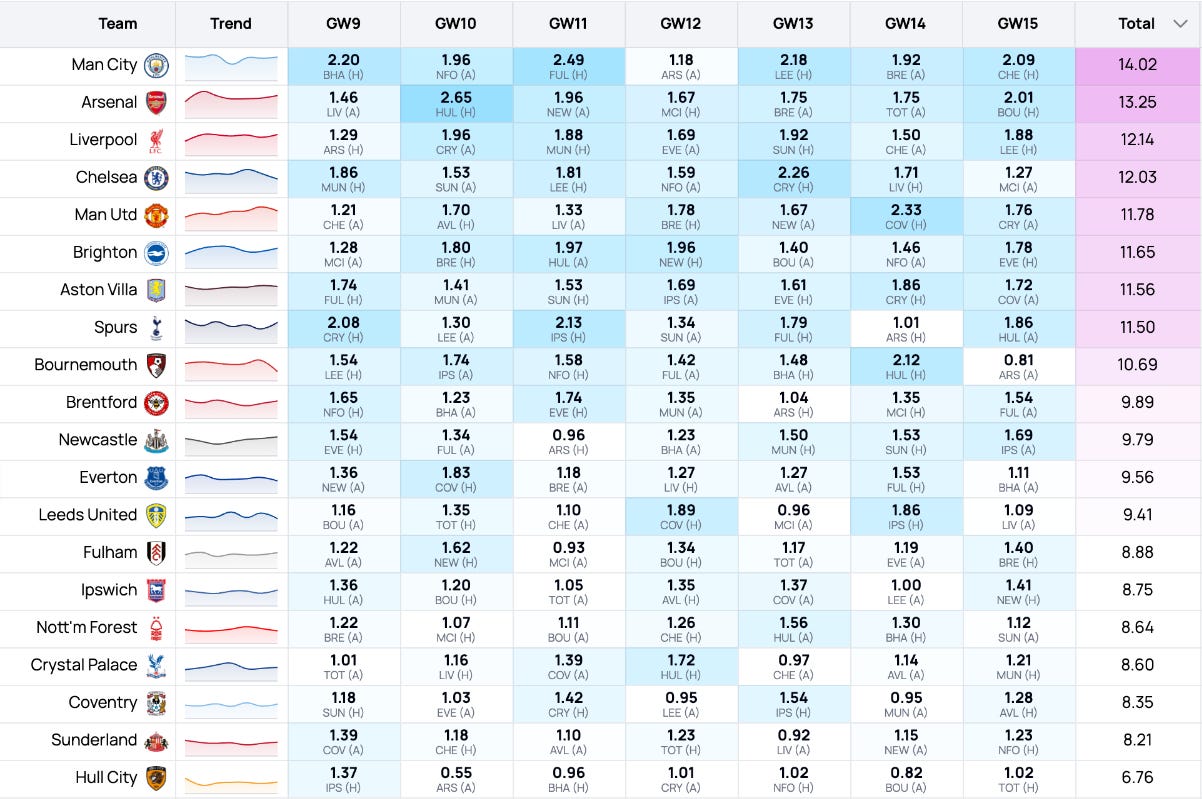
Predicted goals in the next 7 gameweeks according to the Solio Analytics model
In this campaign, we have a modest sample of 571 minutes, and he had a minor muscular issue, but even in those noisy surroundings, there are plenty of positive signs.
Isak stays in the box a lot, moves well to receive the ball, arrives in great goal-scoring positions, and creates separation to take many shots. So far, he’s on 3.15 shots, 0.67 xG, and 0.85 xGOT p90.
Rather than quoting expected numbers from 7 games, let’s just say he seems to be making a pact with Erling Haaland (£15.8m), Dominic Calvert-Lewin (£6.1m), and Thierno Barry (£5.6m).
A pact to take shots only centrally:
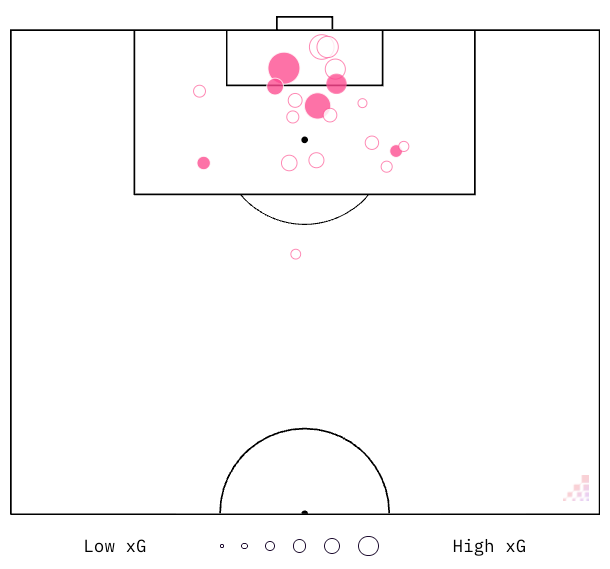
Sure, it’s not perfect, and there’s still some room for improvement. But it’s pretty sweet.
The great thing about his performances is his consistency – he played great in essentially all fixtures this season, which is rare.
💡 It’s just about staying healthy over an extended run of games and getting good minutes. With fixture congestion ahead, that’s not a guarantee, sadly.
Other factors relate to Liverpool and their players. But that’s a story for another article.
I’m not saying to go get Isak next week. Consider all the factors listed at the beginning of the article: usually, it’s more about game mechanics than about looking at picks in isolation.
See you soon!
What to read next?


Join the Data Dribble premium community.
This newsletter is 100% reader-supported. There’s free content every week, but becoming premium unlocks the full edge:
2 deep dives per week
Weekly Q&A
Discord community
Prize mini-league, pre-season content, Subscribers chat and other perks
… for the price of one pint.