


Data Dribble is powered by Solio Analytics and FPL Copilot. Annual premium subscribers will get exclusive perks.
We have a 2.5-season sample of Enzo Maresca in England, which gives us a solid overview and some interesting insights.
In the 23/24 season, he won the Championship with Leicester, following a dominant performance – just 2 expected points behind Leeds United.
That spell is obviously the most difficult to assess, because the team’s quality was much greater than most other teams, with Kiernan Dewsbury-Hall, Jamie Vardy, Ricardo Pereira, and Issahaku Fatawu forming the backbone of the team.
This allowed for a possession-based style of football with an emphasis on positional attacks. You know, a high defensive line, a lot of passes per sequence, slow progression upfield, but also a lot of goals scored after they win the ball high.
💡 In general, Maresca plays a 4-2-3-1 shape that becomes 3-2-5 in possession, with one full-back inverting to form a box shape alongside a deeper midfielder and two higher ones.
To balance this midfield numerical superiority, his wingers are instructed to stay high and wide.
And then there’s a number nine, who… scores goals. Jamie Vardy, Nicolas Jackson, João Pedro, and perhaps some guy named Haaland.
After taking over Chelsea in the 24/25 season, he led them into the Champions League, despite managing the youngest-ever team in a single campaign.
Some interesting numbers:
4th in xPoints, on a par with Manchester City
4th in open-play xG, but 8th for goals scored from positional attacks
2nd-best xG from counters – Liverpool were in a league of their own, but Chelsea ranked similarly to Newcastle, Bournemouth and Crystal Palace
So many dangerous chances conceded when counter-pressed (4th-worst xG conceded) and meh rest defence*
56% possession and 4 passes per possession – only City had more passes
*Rest defence is basically the shape a team maintains while attacking, so that if they lose the ball, it’s already set up to stop a counter. Think of it as the safety net behind the attack.

Those numbers tell a pretty compelling story:
1️⃣ Maresca stuck to his core principles of possession-based, sustained threat, and Chelsea created solid chances from it, though execution was sometimes off. A young squad is certainly one of the reasons, as those players are often inconsistent.
2️⃣ It was the first season, so you can’t teach players (again, very young players) everything at once – the rest defence didn’t work out too well, and building up from the back led to many errors and conceding huge chances.
3️⃣ Maresca also quickly understood that the trend in the Premier League is vertical play, and that you need to be able to pose a threat from fast transitions.
In the following season, Maresca left the team on January 1st, when Chelsea sat 9th for non-penalty xPoints, about 2 points from the fourth team, mainly because they were ranked 13th for StatsBomb xG conceded via FantasyFootballScout.
Ouch.
On closer inspection, they were once again extremely vulnerable after losing the ball while building up in their own third. It was a mix of defensive errors, constant rotation, and lack of discipline.
What Maresca improved was defending fast transitions, where Chelsea looked genuinely good.
They were also great at creating chances from counters, which shows the Italian was really aware of the new trends. Also, only United had more shots from counters than them, despite Maresca keeping faith in keeping possession and playing a lot of passes when on the ball.
Now, using this information, let’s discuss Antoine Semenyo.

Antoine Semenyo: What’s his role now?
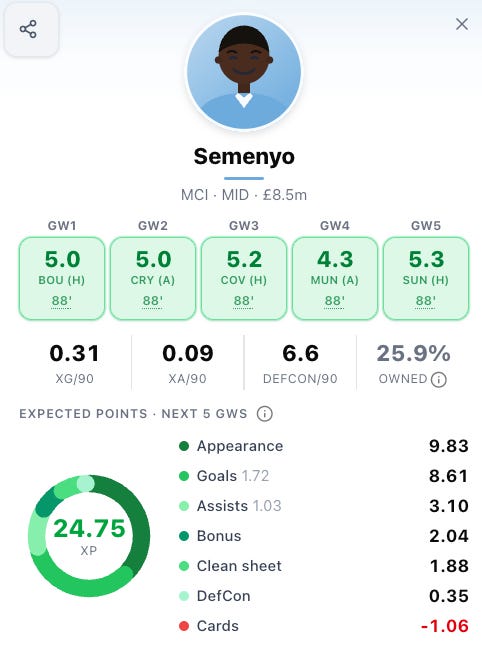
Copilot’s model is bullish on him.
Also, you can see there are many routes to points:
And he’s a hot topic on FPL X this week.
One phrase you hear all the time is that Maresca’s wingers have “high usage”.
In other words, they are central to everything.
“In some games Guardiola wanted me wide, some games he wanted me inside a little bit more, depending on our opposition. Enzo is just about being out wide and when you get the ball, create opportunities. It’s exciting.” - TheAthletic
This Semenyo’s quote is pretty telling.
I wouldn’t place too much weight on all those Semenyo assists in pre-season just because they happened.
They aren’t a signal he’ll replicate that rate during the season.
For a million reasons, pre-season performances aren’t predictive – teams are at different stages of the training process, team quality varies, the positions Semenyo played varied, and there was no Jérémy Doku, which changes a lot. The dynamics will be different. You need to dig deeper to get a clearer picture.
You just need to be aware of the following facts:
1️⃣ Maresca’s teams (as discussed in the previous section) are strong in transitions, which suits Semenyo – a pacey player with experience of Iraola’s intense system
2️⃣ Semenyo WILL be asked to create for others
3️⃣ Jérémy Doku will most likely play on the left
4️⃣ Jérémy Doku will also create a ton
At Leicester, Maresca’s preferred duo was Stephy Mavididi and Issahaku Fatawu, two dribbly boys who averaged more than 5 dribbles per game. Fatawu, in particular, was highly effective when taking on defenders.
Stephy Mavididi (left winger): 2 shots, 0.14 xG, 0.17 xA, and 6.7 entries into the box per 90. Most of his threat came from carrying the ball into the box and delivering final passes from there. He was quite a poor crosser, but he contributed with a high volume of cutbacks and many vertical passes from the half-space.
Issahaku Fatawu (right winger): 2.20 shots, 0.16 xG, 0.38 xA, and 7.8 entries into the box. Compared to Mavididi, he’s more of a crosser and passer. In fact, his crosses were among the best in the league. They were highly effective from the wide areas, but those from deeper areas were great too. He played not only amazing deliveries to the back post but also a variety of other passes from cutbacks.
Does this duo remind you of someone?

Maresca right now:

For comparison, Kiernan Dewsbury-Hall’s goal threat was higher, with 1.9 shots and 0.25 xG. However, this doesn’t mean Maresca kills his midfielder’s goal threat entirely.
At Chelsea, Noni Madueke had his best season, in my opinion, as his right winger. It was the season when he did this:
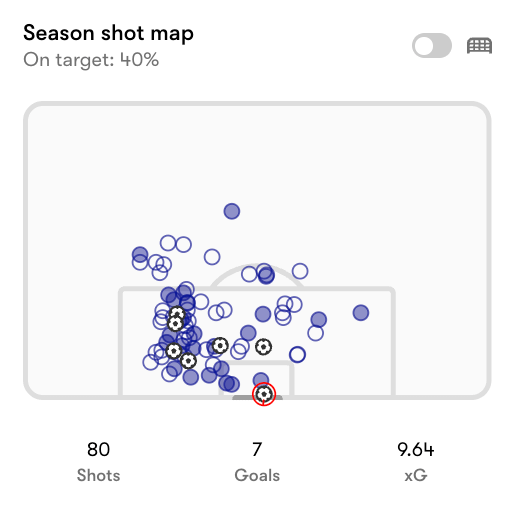
He was super intense back then
3.50 non-penalty shots and 0.40 non-penalty xG (both at the 95th percentile), plus 0.15 xA on top of that.
When it came to shot creation, there were passes inside the box, deep crosses, and cutbacks, with more than 55% of his entries into the box coming from his runs.
Jadon Sancho, on the other flank, offered a combination of passes and runs with very little goal threat. He averaged just 1.20 shots and 0.08 xG (plus 0.16 xA). Again, a huge chunk of his creativity came from passes after arriving inside the box, but he was pretty active in half space too. He almost didn’t cross.
In his last Chelsea season, Maresca played mostly Pedro Neto on the right and Alejandro Garnacho on the left, so he had plenty of running and crossing power at his disposal. Again, both players produced many passes within the box and from the cutback zone, and he utilised their other strengths too, mainly through Neto’s crosses.
💡 Clearly, you can see his wingers arriving in the box and often playing cutbacks, which is the most dangerous pass you can play in the final 3rd.
Antoine Semenyo is synonymous with arriving in the box and playing cutbacks.
From what I’ve seen, Semenyo should have a lot of creative duties and fit that system perfectly. As a by-product, there should be assists.
With an £8.5 million price tag, as an FPL manager, you also want goals from him.
So, will he score goals, or is there no value?
The fact is, no one will tell you. All we can do is assess what has already happened and put it into proper context.
Semenyo can score goals (duh).
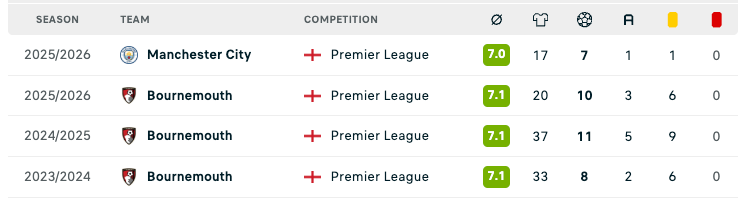
And the current Solio Analytics’ predicted points acknowledge this dual threat:

Do you remember the earlier point about Maresca realising that you must execute your transitions, and how, despite favouring positional play, his teams consistently create high-xG chances from counters?
Well, Semenyo’s goal-scoring potential comes from all sorts of transitions, runs on the back post, or dribbling and running into the box against a more settled block.
He should get his shots. Part of this is that Doku is a creator-first winger, not a goal-scorer. He never has been in his career, and we have a sufficient sample size to say he won’t be this season. Not in this team.
Someone needs to accompany Haaland as a goal-scorer, and it will most likely be Semenyo, and potentially Phil Foden, if he gets good minutes, constantly competing (likely) for them with Rayan Cherki. The French also isn’t a 10+ goals-every-season type of player.
I often see people saying Semenyo’s best position is on the left, and that he possibly settling on the other flank is worrying. That’s a form of recency bias, though.
Let’s not forget that in the 23/24 season at Bournemouth, he played the majority of his minutes on the right, with 2.7 shots, 0.20 xG, and great finishing numbers.
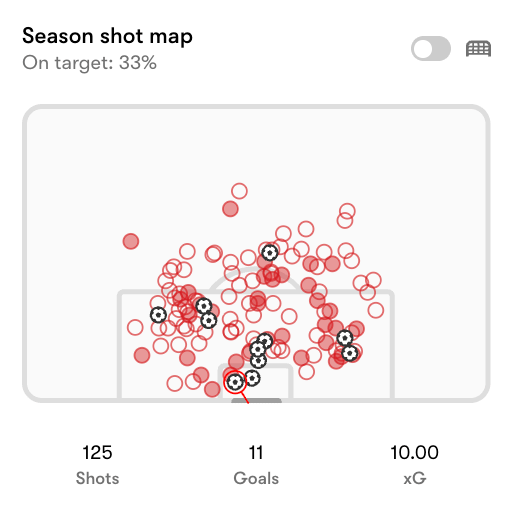
A season later, he was simply outstanding there, averaging 3.60 non-penalty shots, 0.37 non-penalty xG, and 0.19 xA. With the previous Premier League season in mind, these are almost unicorn numbers.
Nothing to worry about.
I also checked, and there’s a good variety in how Semenyo scores his goals – yes, he scores a lot from transitions, but he also has many goals against deep blocks.
Should you have Semenyo in your Gameweek 1 draft?
Well, there are so many factors that affect this. It mostly depends on your team’s structure and the chip strategy you’ll play, because fitting in an £8.5m midfielder is quite challenging.
There’s definitely an argument for waiting to see how his final product pans out. But there’s also an argument that if you own Haaland, Semenyo flooding him with passes isn’t the worst idea… (if you’re less hedging, more synergies type of manager)
But let me tell you one thing – I don’t see any reason to pay £1m more for Cole Palmer if you’re considering starting with him. Not until Palmer shows he can be the 23/24 & 24/25 Palmer again.
By the way:
If you want to improve your tactical understanding of the game, or simply want some amazing Manchester City content throughout the season, I recommend you follow my friend Alex:

What about other picks?
There are obviously Erling Haaland, Nico O’Reilly, Joško Gvardiol, Phil Foden, Marc Guéhi or Elliot Anderson.
There’s still so much we don’t know before Gameweek 1, and all you can do is make educated guesses, though I have some idea of what could happen next.
🚨 Let’s save it for the 2-part pre-season guide covering all 20 Premier League clubs – the first piece will hit Data Dribble tomorrow evening (or Friday morning at the latest).
See you very soon!


If you look at Semenyo's positions after he joined City it didn't matter where he played, he was banging in the goals. Wide right in a 4141, left in a 433, support striker, even as one of the two behind a front two in a 4222. I think he'll carry on where he left off last season
Do you think going for Haaland, Bruno, Mbeumo and Semenyo is too much? Are they all considered “premiums”?