



Welcome back, reader!
First, sorry for the dramatic title, but it felt right after I finished the article.
We expect injuries, suspensions, surprising benchings, and all the chaotic stuff we’re used to during the festive period.
But there could be more. Something brewing beneath the surface, waiting to explode.
I dived deep into the current FPL and Premier League landscape to see what’s been happening with goals, DEFCONs, defenders, aerials, forwards, and more.
There will be a lot of football very soon, and it’s a good time to get as much clarity as possible. Actually, it’s a good thing I’m publishing this during the international break, as there is a lot of data, and you might want to take it in a few servings.
But if you do, you will get a good sense of what’s happening right now and how FPL is changing.
🌶️ What’s on today’s menu?
Are there more goals at Christmas?
Is FPL healing after the last anomalous season?
One important thing to watch for with set pieces
Forwards are crushing it, and they still haven’t hit the ceiling!
You NEED to load up on certain defenders because they will produce even more
The truth about midfielders: Is it really that bad, or are there positive signals?
The big DEF reveal: Why does it feel like there are suddenly more picks? (It’s not just DEFCONs)
And much more!
Last season stunned the FPL world. Is it healing yet?
Goals.
Is there anything else that can, at the exact same time, make one person happy and another sad and disappointed?
But don’t you worry, reader.
Today, we’ll all love them equally.
In previous editions of these international break articles examining the current Fantasy Premier League trends and meta, we learned that the previous campaign was a total outlier.
And it all happened at once:
1️⃣ Fewer goals
2️⃣ Larger share of set-piece goals
3️⃣ Broader Premier League meta changed (this long-ball, long throw, second-ball, set-piece, and long goal-kick style of play)
4️⃣ Forwards offered very little value for money
5️⃣ Points scored by premium picks dropped sharply
6️⃣ More players were scoring more points, which led to a greater spread of points among players
7️⃣ An introduction of DEFCONs, and the meteoric rise of new DEFCON papi’s
Frankly, it was an overwhelming experience for most of us. Today, I will try to offer more clarity on how the league is evolving and how to respond.
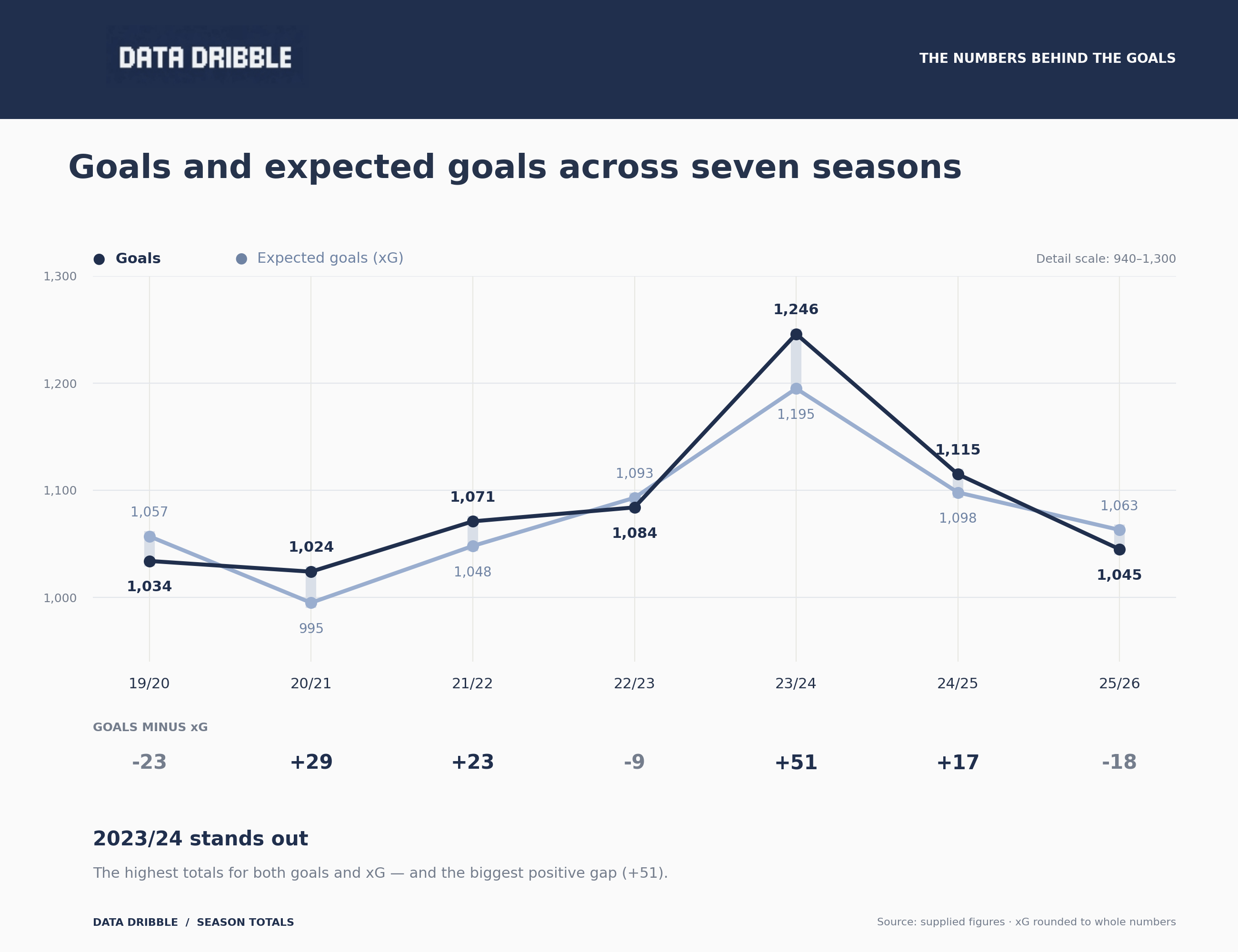
Last season, Premier League players scored the fewest goals since 20/21: 1,045, a 6.3% decrease from the previous season. In absolute terms, there were 70 fewer goals.
The season before, there was already a humongous 131-goal decline.
Continuing with a simple maths exercise, last season there were 201 fewer goals than in the record-breaking 23/24 season. Imagine how many FPL points that is, with all those goals and assists.
💡 The 2023/24 Premier League season recorded the most goals ever: 1,246 in 380 matches, an average of 3.28 per game.
It broke the previous all-time total of 1,222 set in 1992/93.
That was quite a feat, because in 1992/93 there were 22 clubs and 462 matches, not 20 and 380 like these days…
Here’s how the total number of goals and expected goals (OPTA) evolved in the last 7 seasons:
One of the most discussed topics across different analytical websites was the meteoric rise in set-piece goals. Not only did the raw number of those goals go up considerably, but they also accounted for the second-highest share in Premier League history.
Across the six seasons from 2019/20 to 2024/25, players scored an average of 228 set-piece goals per season from 234 xG.
In the 25/26 season, we saw 287 goals from 289 expected goals. Year on year, goals scored from this type of attack rose by 25%. The share of set-piece goals also grew from 20.6% to 27.5%.
(In other parts of the article, we’ll go more granular.)
Now, what’s been happening in those 10 Gameweeks of the current season? How does it compare with the anomalous previous one?
Sometime around Gameweek 5, I wrote an article titled that sparked some much-needed hope of a better FPL world to come:

🚨 Spoiler alert: I carefully hinted that if that trend, driven by a wobbly, tiny sample size, continues, MIDs could score higher and FWDs should be more valuable.
The fact is, there are *drumrolls*…
*drumrolls continue*
… noticeably more goals and more chances created than in the same period last season.
Players generated 292 xG and scored 273 goals, up from 264 xG and 268 goals last season. I know, it is only five more goals. But it’s 28 more expected goals, almost 3 per gameweek.
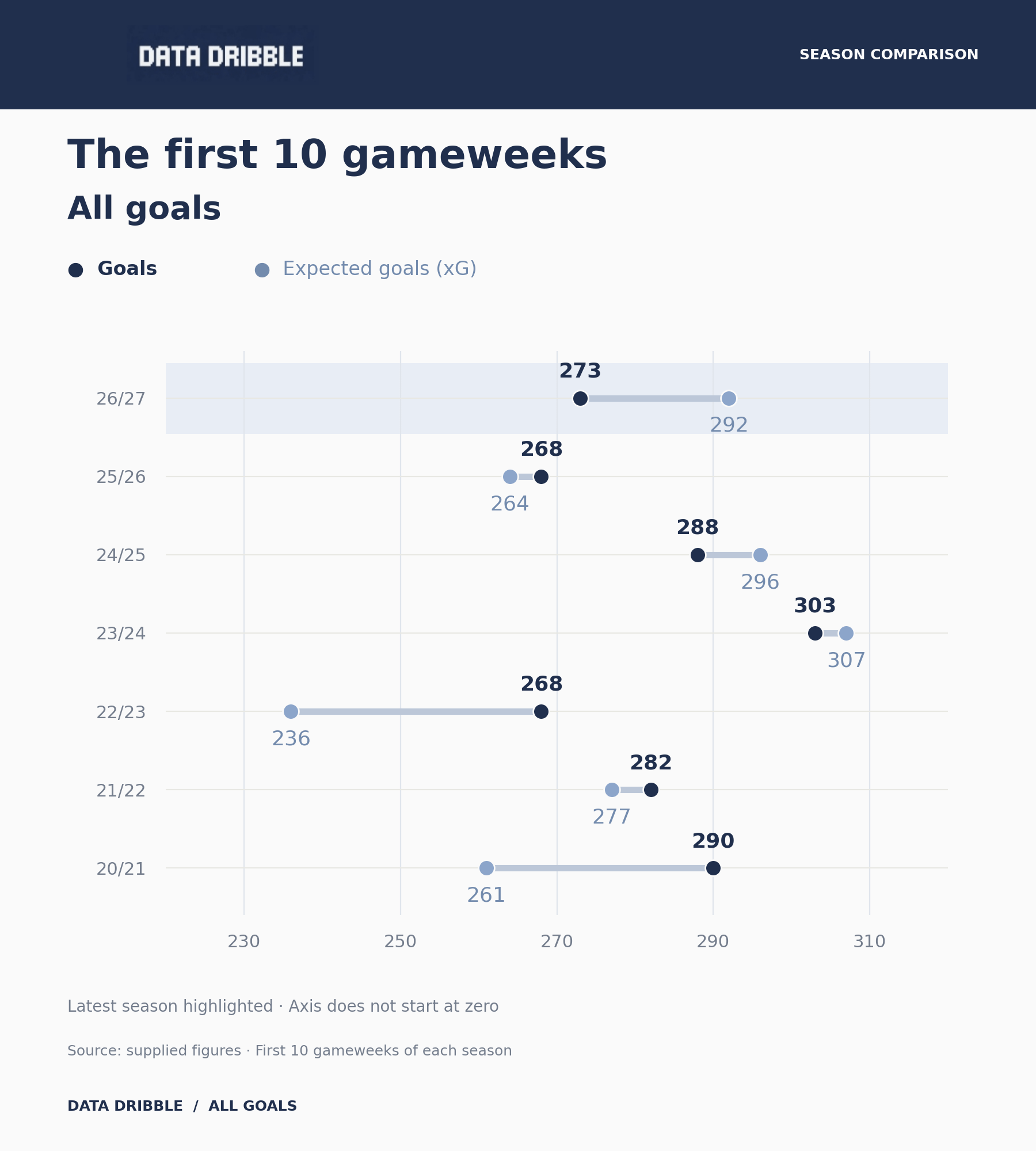
It’s still far from a record-breaking season, but it’s a massive increase, and without that underperformance, this would be happy times. Now, why aren’t players more composed in front of goal? Because when you look at it, it’s a strikingly poor run compared with those seasons before.
Frankly, it’s a 10-game sample size, so there could be a million reasons: bad luck, great shot-stopping, more poor finishers in the league, World Cup fatigue, general fatigue from all the football, and players are just people, etc.
One thing caught my attention, though.
Players scored 215 open-play goals from 220 open-play xG.
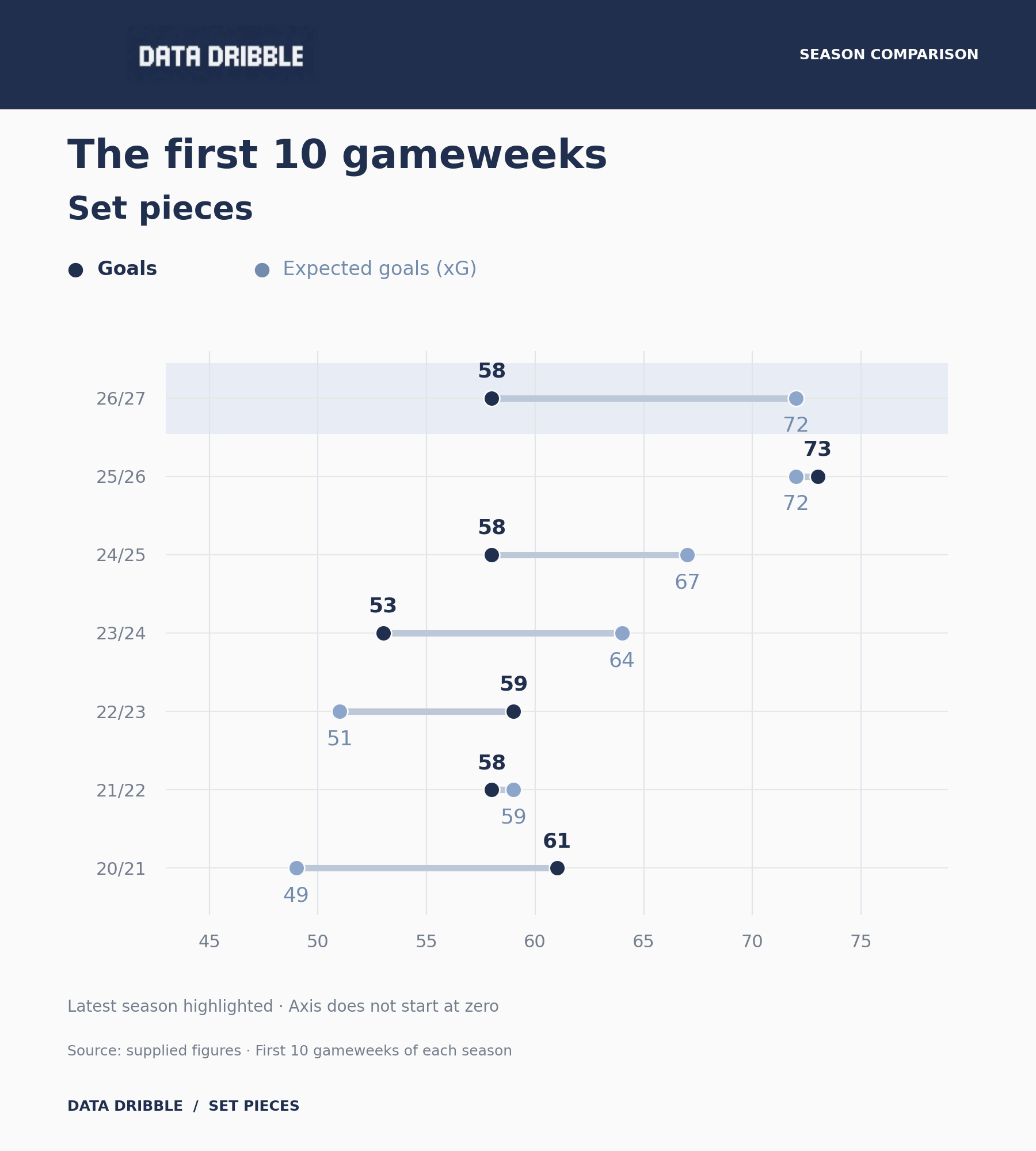
💡 But just 58 set-piece goals from 72 set-piece xG.
Last season, the set-piece xG was identical, but players scored 73 goals.
If we isolate corners, it’s obvious where the underperformance comes from:
Corners this season: 23 goals from 36 expected
Corners last season: 43 goals from 37 expected
Take a moment to catch your breath and imagine how many more hauls your DEFCON defenders could have delivered.
But let’s not be overly dramatic. As you can see from the visualisation below, set pieces are extremely volatile in that small sample:
Now you’re thinking – of course, dummy. It’s how set pieces work. It’s much easier to score open-play goals because, in a set-piece phase of play, there are many more headers. And second balls, so you shoot with so many bodies in front of you.
Well, you’re right.
And at the same time, you are not.
I’ll explain: