



Nerd stuff alert.
This season of Fantasy Premier League (FPL) feels somewhat different.
A direct result of the entire league feeling different.
Over the past few months, I have published several articles on this new Premier League landscape, presenting compelling data that suggest we are witnessing less exciting football than in previous seasons.
1️⃣ There are fewer goals, and their distribution has changed dramatically: set-piece goals are on a massive rise.
2️⃣ The number of headed duels has skyrocketed.
3️⃣ Long throws have become extremely popular: the number of both expected and actual goals from long throws has doubled (you’re seeing them every gameweek now).
4️⃣ There are significantly fewer shots from counter-attacks and counter-pressing, as teams often opt to play long passes to bypass the press and become more risk-averse.
5️⃣ The ball is in play for about 1 minute and 34 seconds less. Although that doesn’t seem like much, you can do a lot in that time – go ask my girlfriend.
If you’re interested, you can read about this in one of my previous deep dives:
The Premier League is still shitball — but midfield is king now

I’m not going to beat around the bush—in the Premier League this year, we’re seeing noticeably less exciting football than in previous seasons.
These are the facts. Numbers don’t lie.
But people often do.
The current landscape is filled with strange narratives, which you should always take with a pinch of salt. In our FPL bubble, the focus is often on shots.
When Harry Wilson and Morgan Rogers (back when he was still a people’s darling, so… quite a while ago) are on a heater, shots from outside the box are suddenly seen as a clever tactic that works perfectly, and Premier League teams are beginning to use these to exploit a skill that this surface-level xG can never truly capture…
You’ve probably heard these opinions many times this season.
They are loud and super convinced.
I have quite a bit to say about that, but first, let’s take a quick landscape check.

Set pieces, no goals, bla bla bla
Some say that this is the worst Premier League season ever.
And as is often the case, the truth lies somewhere in the middle. Partly, it’s fading-effect bias, a tendency to remember past events more positively than we actually experienced them. At the same time, the evidence is clear.
We’re on track to see the fewest non-penalty goals in the past four seasons: just 1,036, compared to an average of 1,148 over the previous three campaigns. *Doing proper maths* That amounts to 112 goals fewer.
For example, during the 23/24 season, there were 1,246 goal celebrations. Yes, including those your FPL captain was involved in just as a spectator.
❗ If we compare it to the current pace, we’d see almost 6 goals fewer per Gameweek than two seasons ago.
It’s impossible to specify an exact number of FPL points that goals would earn, but it would be hundreds and hundreds.

The striking difference is the meteoric year-on-year rise in set-piece goals.
Last season, 20.6% of all goals came from these. This season, that figure has risen to 27.2%, making set-piece goals 32% more common than last year.
In absolute terms, we are on track to see 52 more goals from dead-ball situations and 143 fewer open-play goals.
Okay, now the juicy one:
Many say that this season, teams are sitting in deeper blocks than before, forcing opponents to take more long-range attempts, as it’s often too crowded inside the box.
But in reality, there is no data-backed evidence of this happening.
The average height of the defensive line is essentially the same as last season, with only a few centimetres difference. It’s even higher than in the season that holds the record for the most goals scored.
What has changed is that defensive units are more compact, rest defences work better, and teams are harder to break down when they drop deep. But there is still only indirect evidence of this, such as more long balls than ever, and, as already mentioned, fewer goals.
And it certainly doesn’t imply a trend of teams responding by shooting outside the box more often.
You can’t possibly say this without any solid proof.
The real numbers behind long-range shots
You may have seen some version of the well-known image of NBA shots evolving over time:
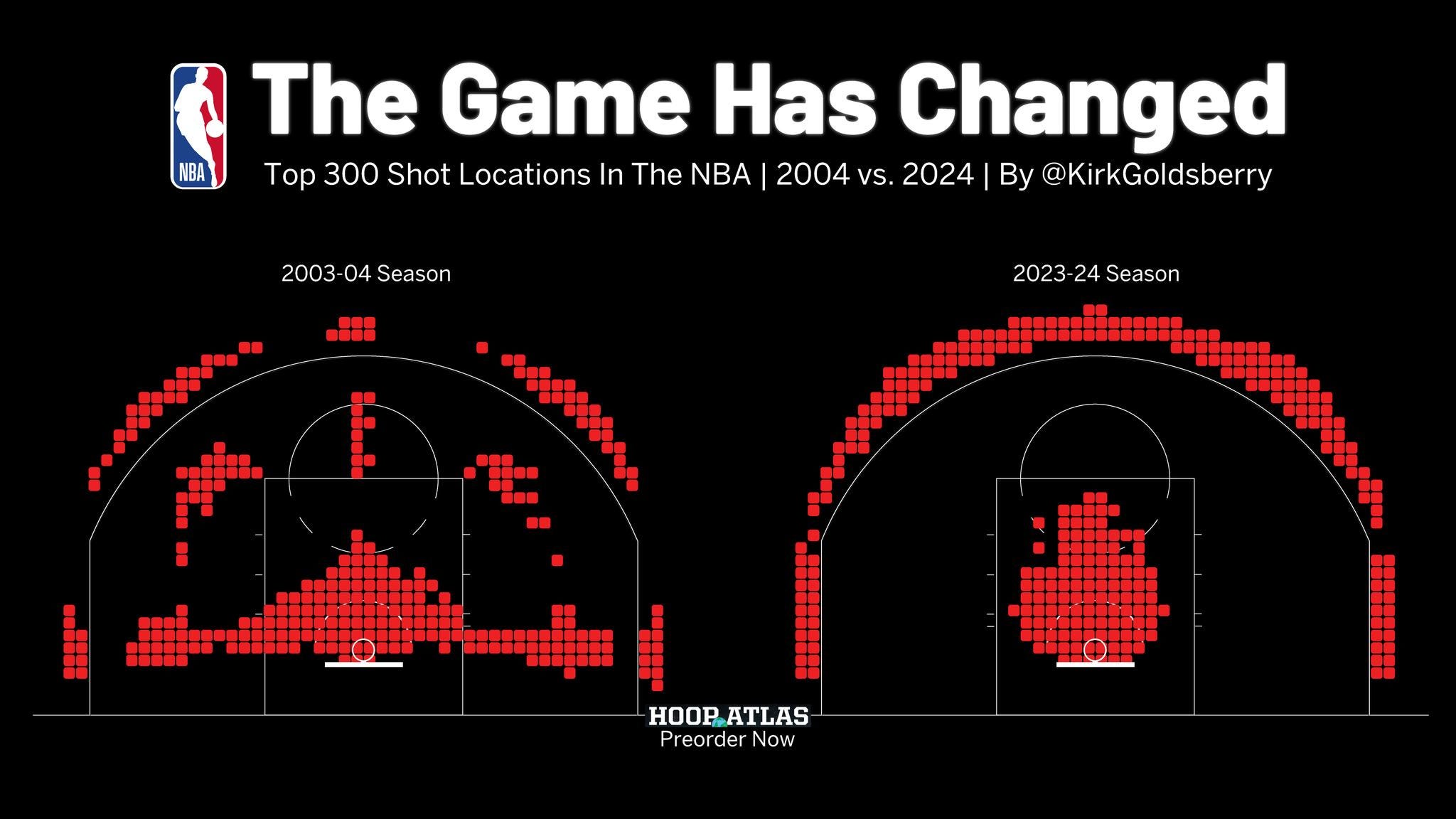
Some people use it to speculate whether something similar could happen in football, even on a smaller scale.
Which is kinda dumb, since we’re comparing two very different sports.
But, but there are so many long-distance shots, right?
Players are scoring bangers all the time this season!
Well, not exactly:
% of shots taken outside of the box in the 24/25 (league’s average): 32%
% of shots taken outside of the box in the 25/26 so far (league’s average): 33%
The difference is minimal, meaning teams are not suddenly shifting strategy to exploit defences with long-range attempts.
The fundamentals stay the same.
Yes, xG has its limits in measuring the danger of those shots, because it’s noisy and volatile. Also, the sample size of these long-range shots is smaller than that of shots in the penalty area, where most of the fun happens. However, shots inside the box are much more dangerous than long-range attempts. There’s no doubting that.
There’s even noticeably less outside-the-box xG than in the same period last season, but again, I wouldn’t assign too much significance to that.
There have been 112 goals from outside the box compared to 106 goals in Gameweek 31 last year.
An increase from 3.4 to 3.6 per gameweek.
xG per shot decreased by 2.3%. Players are not taking more dangerous shots on average.
But what about these talented shooters we like to pick in FPL?
Trust me, screamers are still rare
Look, I know it’s nice to shout “Shoooot!” from the stands now and then, but do you know why?
The dopamine hit when a player scores feels so good because it’s rare. It’s very, very rare.
An average Premier League player last season converted just 4.4% of his out-of-the-box attempts. This season, it’s 4.5%.
Naturally, it’s just an average player. Superb finishers who take these shots more often tend to convert at a higher rate. But perhaps not as often as you might expect.
Let’s see some specific examples:
Riyad Mahrez: 8.7%
Harry Wilson: 8.4%
Morgan Rogers: 7.6%
Kevin de Bruyne: 7.1%
James Maddison: 6.9%
Dominik Szoboszlai: 5.1%
Bruno Fernandes: 4.1% (surprising, right?)
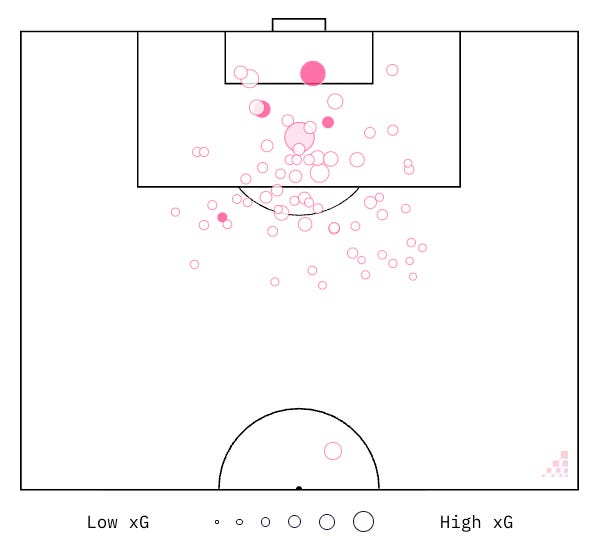
Morgan, you’re brilliant, but let’s be realistic
The stable percentage of shots taken outside the box, and xG/shot strips away the most interesting tactical narratives and leaves us with a simpler, less sexy truth.
Some popular players are simply overperforming this season, which creates the illusion that something big has changed.
In fact, nothing has changed.
Once a player hits a hot streak, they always draw attention, and narratives start to form around them. Then they inevitably regress to a more normal level. They might still perform well, but it’s not a series of bangers like before. This happens several times each season with different players, as reliably as clockwork. People tend to forget, and can lose their minds when a new player with “form” shows up.
An article on The Athletic earlier this year examined how likely it was that Villa would score their 13 goals from outside the box based on their xG. Their level of overperformance would be expected to happen in just 0.03% of cases.
Yes, 0.03%.
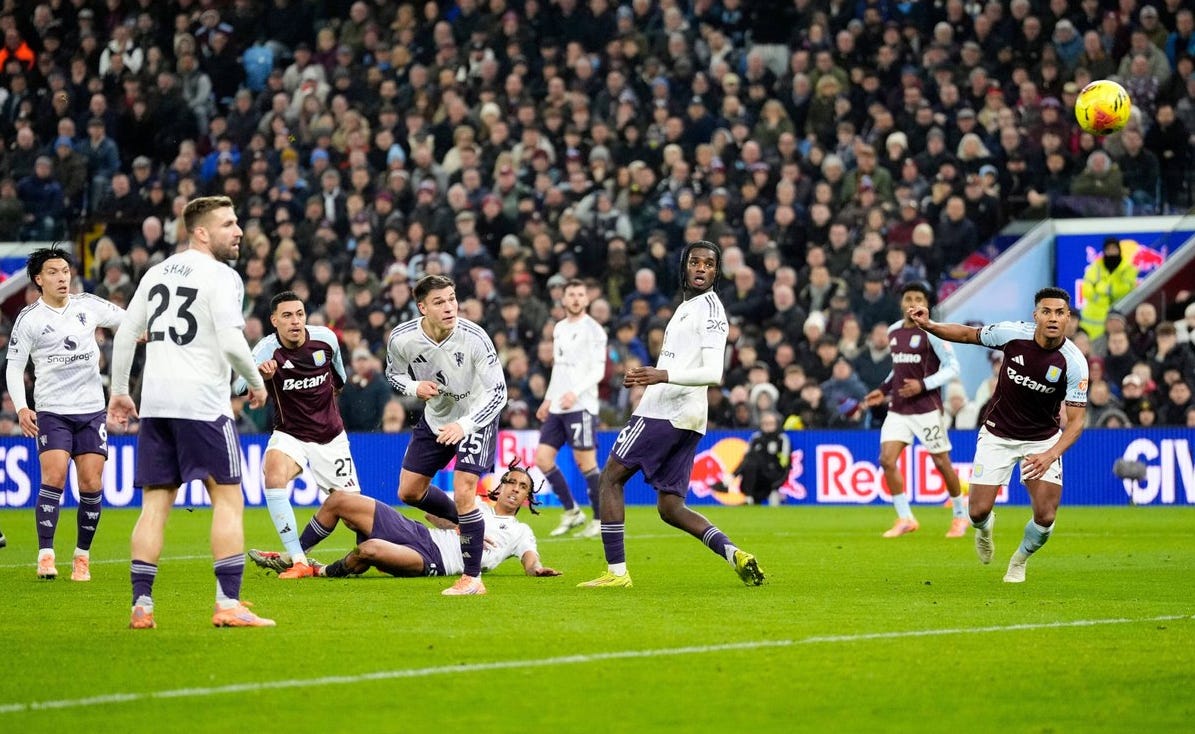
Those debates gave us the iconic Morgan Rogers phrase: “It feels like a crime. I’m scoring, and xG is putting me down.”
No one’s putting you down, Morgan. You’re a professional who secured his place in the starting eleven of the team that’s ranked 4th in the most competitive football league in the world. You’re an elite athlete.
And you are overperforming your xG over 125 shots with a great post-shot xG, so it means you CAN shoot.
Plus, xG tells you only the quality of the shooting position. It doesn’t tell you the quality of the decision: some of these shots might be the best choice at that specific moment, while passing would be less valuable.
It’s not a criticism. It’s simply describing current events and their likelihood. A sports journalist does this to tell stories, and I do it both to tell stories and to try to improve in this fun analytical game called FPL.
I’ve never played football professionally, but I have spent enough time around clubs and players to know that decision-making on the pitch is far more complex than event data (basically, data that we use in FPL) suggests.
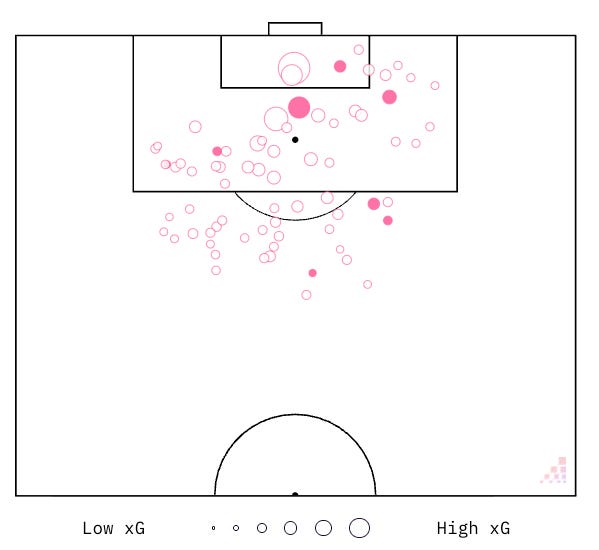
Let your best players take those shots
When it comes to the biggest xG overperformances for shots outside the box this season, Villa are alongside Arsenal, Bournemouth, Fulham, City, and West Ham:
Aston Villa: 128%
West Ham: 82%
Fulham: 80%
Bournemouth: 62%
Arsenal: 41%
City: 37%
Looking at those teams, you’re probably not shocked, especially when you realise which players might be responsible for it.
Morgan Rogers, Harry Wilson, Declan Rice, Leandro Trossard, Antoine Semenyo, Phil Foden, Rayan Cherki, and Jarrod Bowen all have excellent striking technique and finishing. Do not worry, I checked each one thoroughly using a large sample of shots. No exceptions there. There’s a direct correlation.
I suspect it’s not only execution quality, but also decision-making.
Are there any metrics that could highlight both? The ball needs a clear path to the goal, so you need to manipulate it into good areas to boost your chances before striking. Those players usually have a good combination of shot-on-target percentages and blocked shots.

Antoine Semenyo is a unicorn, with only 13% of his shots blocked, despite averaging 2.20 shots per 90 (about 75th percentile).
Studies by The Athletic show that players who regularly attempt shots from outside the box tend to outperform xG by a much greater margin than those who do so less often.
That makes sense. You know you’re good at it, so you try it more often.
For FPL, finishing is just one of the components. And not too important.
The most important is still to find someone with a substantial volume of shots from good positions – a lot of shots and xG per 90 minutes. Being an average finisher is sufficient in that case.
Being a fantastic finisher is a nice bonus or a decider if you have someone with creative, DEFCON, or bonus potential, and you’re faced with a close decision because that player shoots less and often from wide angles or outside the box.
However, it’s certainly useful to have an awareness.
How does shooting from a distance look on a team level?
The curious case of Liverpool
On a team level, Liverpool are an interesting case.
Arne Slot is one of the managers who has been quite vocal about his team's struggles on the pitch this season.
He’s frustrated by how often the teams go long against Liverpool. At one point in the season, aerial duels contested in Liverpool games rose nearly 70%. They have the best player in the air in Virgil van Dijk, and Ibrahima Konaté is also good, but constantly battling for second balls must be frustrating, especially when… you don’t win that many second balls, which can lead to conceding chances.
But hey, you have to adapt.
Did they?
Yes, they did.
GWs 1-18: the lowest success rate in their defensive third (!)
GWs 19-28: 4th best, only behind City, Brighton and Brentford
It’s an excellent case study of recognising a problem, solving it, and improving your team.

Slot also isn’t happy about facing low blocks often, which I find, frankly, quite strange, because that’s what happens to every elite team, and you need to find a solution. It’s no different for other title contenders.
Let’s look at the average defensive line height against them.
Arsenal: 40.70 meters
Liverpool: 43.3
Manchester City: 43.9
Brighton: 44
Chelsea: 44.6
Average: 46.4
I didn’t hear Mikel Arteta or anyone else complain about playing against low blocks…
Anyway, let’s return to the main topic: those long shots. The data shows why Slot is so frustrated with settled defences. In the 24/25 season, Liverpool took 26% of their shots from outside the box. This season, it’s a staggering 35%.
This is not only a massive increase but also one of the biggest shares in the Premier League this season:
Nottingham Forest: 40% of their shots come from outside the box
Bournemouth: 40%
Aston Villa: 37%
Wolves: 37%
Brighton: 36%
Liverpool: 35%
If you’re asking how serious a problem it is for the Reds, the answer is: quite serious.
They rank 4th in non-penalty xG created, with 49.5 xG (1.6 per game), while Chelsea lead with about 4.3 xG more. However, a regular Data Dribble reader knows that distribution matters.
Such a large proportion of shots from distance means more low-quality shots. Liverpool are 10th in the xG per shot metric, which is a red flag for a club that was meant to charge for a Premier League title. And while they are getting better at winning second balls, there’s no improvement in this area.
To break through those low blocks, you need to create overloads through pace and individual moments. They have lost much of this compared to the past, especially as Mohamed Salah has regressed from his elite performances. He still generates a solid threat, but the volume is much lower. The main problem is his lack of dribbling and running to create separation from defenders. He’s struggled with that this season.

What about City and some others?
Briefly:
Arsenal stayed at a similar level: 27% versus 27% year on year.
Manchester City are interesting. While Liverpool’s share rose from 26% to 35%, City’s dropped from 37% to 27%. Having such a high share wasn’t necessarily a bad thing: they accumulated a large volume of chances, totalling 11 xG, and scored 14 goals. There was a player quality I already mentioned.
There’s surely some tactical or other underlying logic behind that. Was this because the only real box threat was Haaland, and others weren’t getting inside that often? Nevertheless, their 14 goals from distance were the most in the league. It worked for them.
Brentford? You have to chuckle a bit. They preach a highly analytical approach of “making each chance the biggest possible”. Thomas Frank and Keith Andrews adhere to the same philosophy, and in both seasons, the share is just 24%, the least in the Premier League.
Newcastle: they went from 28% to 37%, perhaps due to lower attacking quality? Alexander Isak was Haaland-level last season, no exaggeration.
We could explore the specific examples in greater detail, but I don’t want to overwhelm you with numbers. Let me know if you’d like similar articles in the future.
Now, let’s take a week off to return refreshed for the final FPL push.
Enjoy the break and see you soon!