


If you’re a regular Data Dribble reader, you already know.
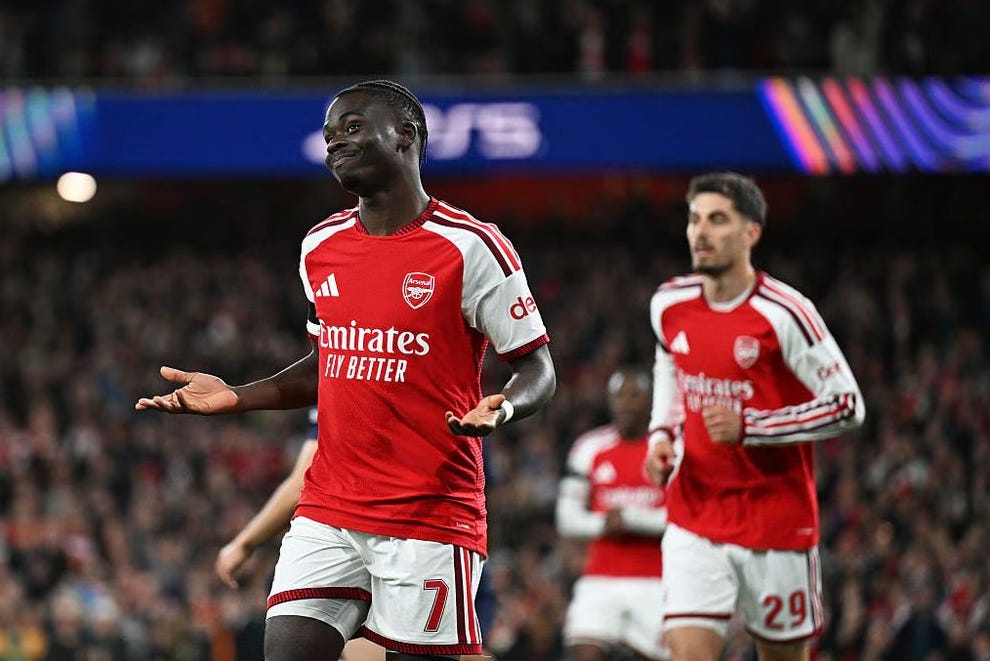
Bukayo Saka last season and Bukayo Saka we’re seeing now are two different men.
Frankly, his transformation is one of the Premier League’s most exciting stories right now. Oh, and did I mention it’s also FPL-relevant?
You’ll see in a minute.
Last week’s edition of the free newsletter

Bukayo Saka: There’s a significant shift in his final product
For a football data analyst, this is a storytelling gift.
We can do a highly accurate analysis of Saka with a sample size of about 19,000 minutes, a luxury rarely available even when discussing other established Premier League players.
The Englishman will always be a dual threat, capable of creating chances while posing a substantial goal threat, simply because of his talent and football intelligence.
Not a Salah-type threat, but even as a chief creator, he could still rack up a substantial volume of shots from high-quality positions (about top 20% in his position). That kind of impact was always there.
Last season, he generated 2.90 shots and 0.27 non-penalty xG, on top of his 0.29 xA per 90, which felt almost like a bonus given how creative he was.
His expected assists were in the 95th percentile, and of 60 passes that led directly to a shot, 45 (75%) came from open play – a hefty share for someone who takes about one-third of teams’ set pieces.
It’s not very surprising that his volume of passes into the box and his key passes were in the top 10% among wingers in Europe’s top five leagues.
Advanced goal probability added models that evaluate both his passing and running (and an impact on his team’s scoring/conceding) put him among a handful of the best players out there.
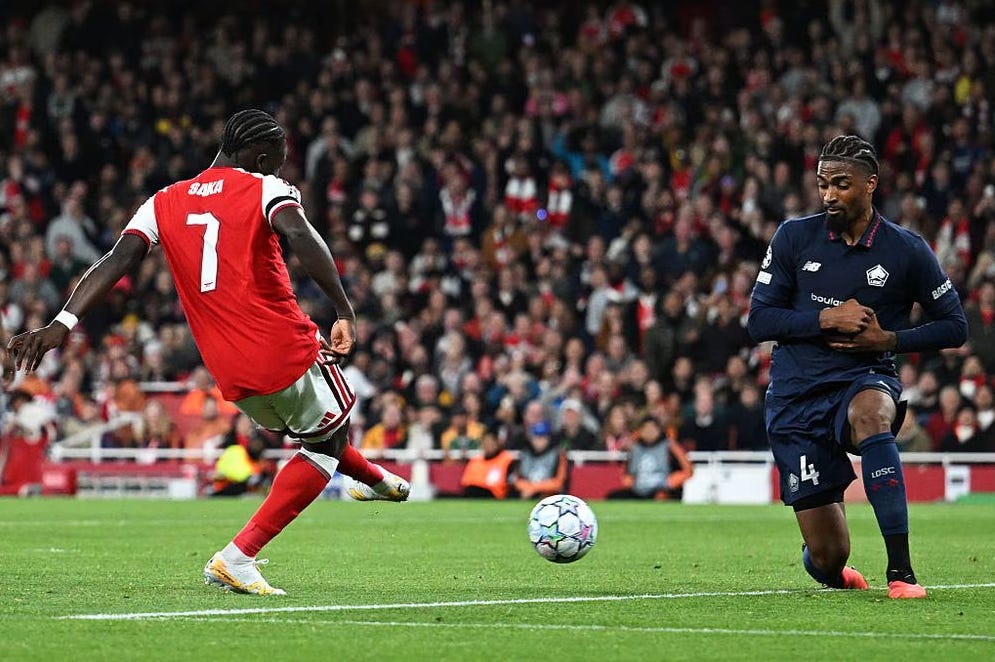
Going even more granular, Saka’s 25/26 version had a huge range of creative passes.
Most of his threat came from high crosses from wide areas and ground passes into and inside the box. He did so in huge volumes.
Thanks to his running and dribbling ability, he also regularly arrived in the cutback zone to play both classic cutbacks and those lovely balls to the far post. Doing this consistently is extremely rare. ❗
In previous seasons, he’s shown he can play crosses from deep and make some fun decisions in half-space, but Martin Ødegaard & Co. play those.
Which means you just let Saka do his thing in those advanced positions.
Imagine the assist tally if Arsenal had a proper number nine…
Anyway.
Let’s circle back to his goal threat.
I know people on social media love to talk about finishing like it’s a matter of life and death.
It’s not. If you have enough shots from nice locations and you’re an average finisher, you’re fine.
And in Saka’s sample of 500 league shots, he’s exactly that. An average finisher. His goals, xG, and post-shot xG tally are largely on par.
Have you ever wondered what would happen if Saka were in the box more often, a little more selfish, stripped of some of his creative duties, and trigger-happy?
Well, this is the season when we might find out...
💡 In the opening 7 gameweeks, Saka’s xA/p90 is 42% lower than his last three seasons’ average, while his non-penalty xG/p90 rose by 85%.
xG per shot went from 0.09 to 0.21.
For comparison, here are some of last season’s xG per shot numbers: Thiero Barry 0.23, Erling Haaland 0.18, Igor Thiago 0.17, Dominic Calvert-Lewin 0.17, João Pedro 0.16.
Now, it’s just a little over 500 minutes, so those numbers will most likely regress, though it’s difficult to say by how much. Still, that shift in distribution clearly signals something is happening.
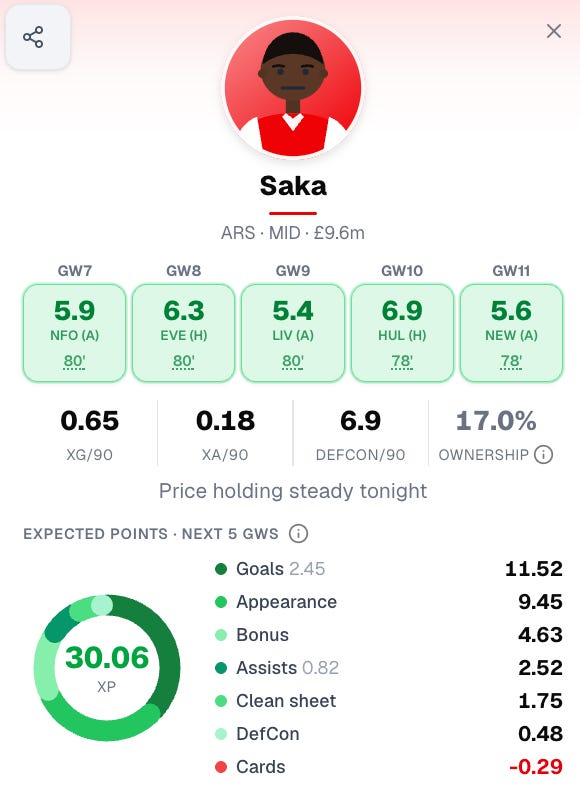
Saka’s predicted points distribution in the FPL Copilot. Good models are already recognising his goal threat
No more crossing, mate
Last season, Saka got the ball into the box 40% of the time by carry or dribble, similar to this season.
💡 This season, however, only 5% of his entries come from crosses, significantly down from 29% last season.
As a result, his overall number of entries into the box with the ball has visibly decreased, as he also makes more off-ball runs there. The number of attempted dribbles has also declined significantly – by 37%.
He’s receiving more passes in the box, and his receptions are closer to goal.
And while his shot volume remains similar to 25/26, he takes his attempts from much more dangerous locations, which has skyrocketed his expected goals.
The word I like to use is centrality – his attempts are more central than ever.
Compare this shot map:
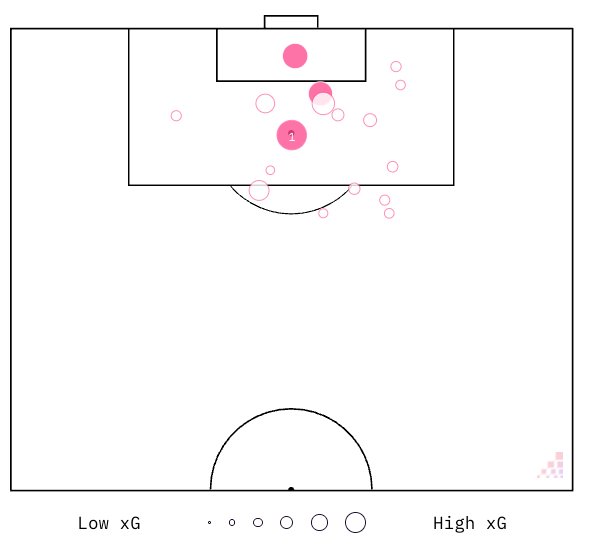
… with any other of his shot maps from earlier seasons. The contrast is stark.
His movement in the box and receiving are elite-striker level so far. So why does he have just 2 open-play goals?
Well, he was unlucky.
He got into those shooting positions and placed the ball well, but the goalkeepers did their job. His xGOT (xG on target) numbers tell that story pretty clearly. Also, of his 12 inside-the-box shots, only 3 were blocked. One of them came after a corner with a lot of bodies in front.
Could this all be just because of a small sample?
Some of it, yes.
But that alone doesn’t explain that shift. If he keeps playing exactly as he is (not guaranteed, of course), this could become one of his highest-scoring seasons. After scoring 6 and 7 goals, respectively, in his previous two Premier League seasons, we might realistically see double digits again:
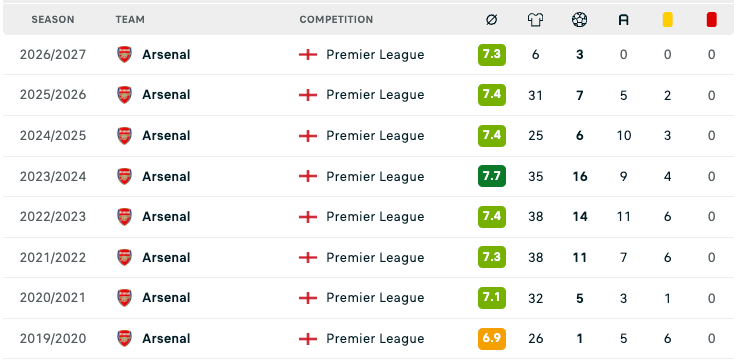
Between the 21/22 and 23/24 seasons, Saka scored 31 open-play goals and 10 penalties.
A few days ago, Mikel Arteta said something that confirmed my suspicion:
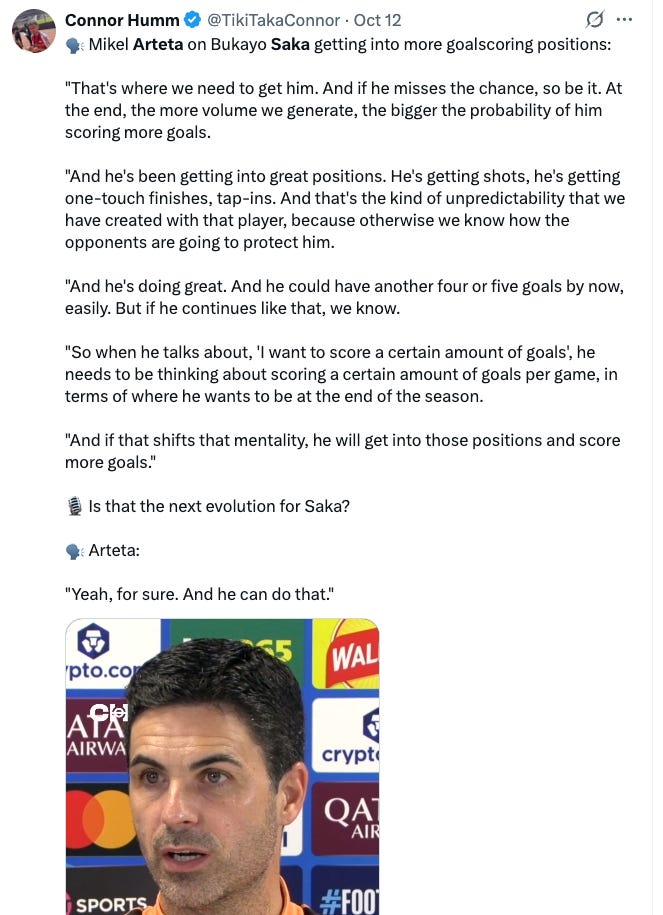
At the end, the more volume we generate, the bigger the probability of him scoring more goals.
And he's been getting into great positions. He's getting shots, he's getting one-touch finishes, tap-ins.
Mikel Arteta gets it.
A reporter asked whether this is the next evolution of Saka.
It’s certainly Saka’s next evolution in FPL, now that he costs £9.6m and goal-scoring wingers are a rare breed in the current landscape.
The points are coming, and with 16.7% ownership, they will move the needle.

According to the Solio Analytics model, these are the Premier League’s best attacking fixture runs over the next 8 gameweeks
What to read next?


Join the Data Dribble premium community.
This newsletter is 100% reader-supported. There’s free content every week, but becoming premium unlocks the full edge:
2 deep dives per week
Weekly Q&A
Discord community
Prize mini-league, pre-season content, Subscribers chat and other perks
… for the price of one pint.
Timing the Palmer to Saka switch seems key