


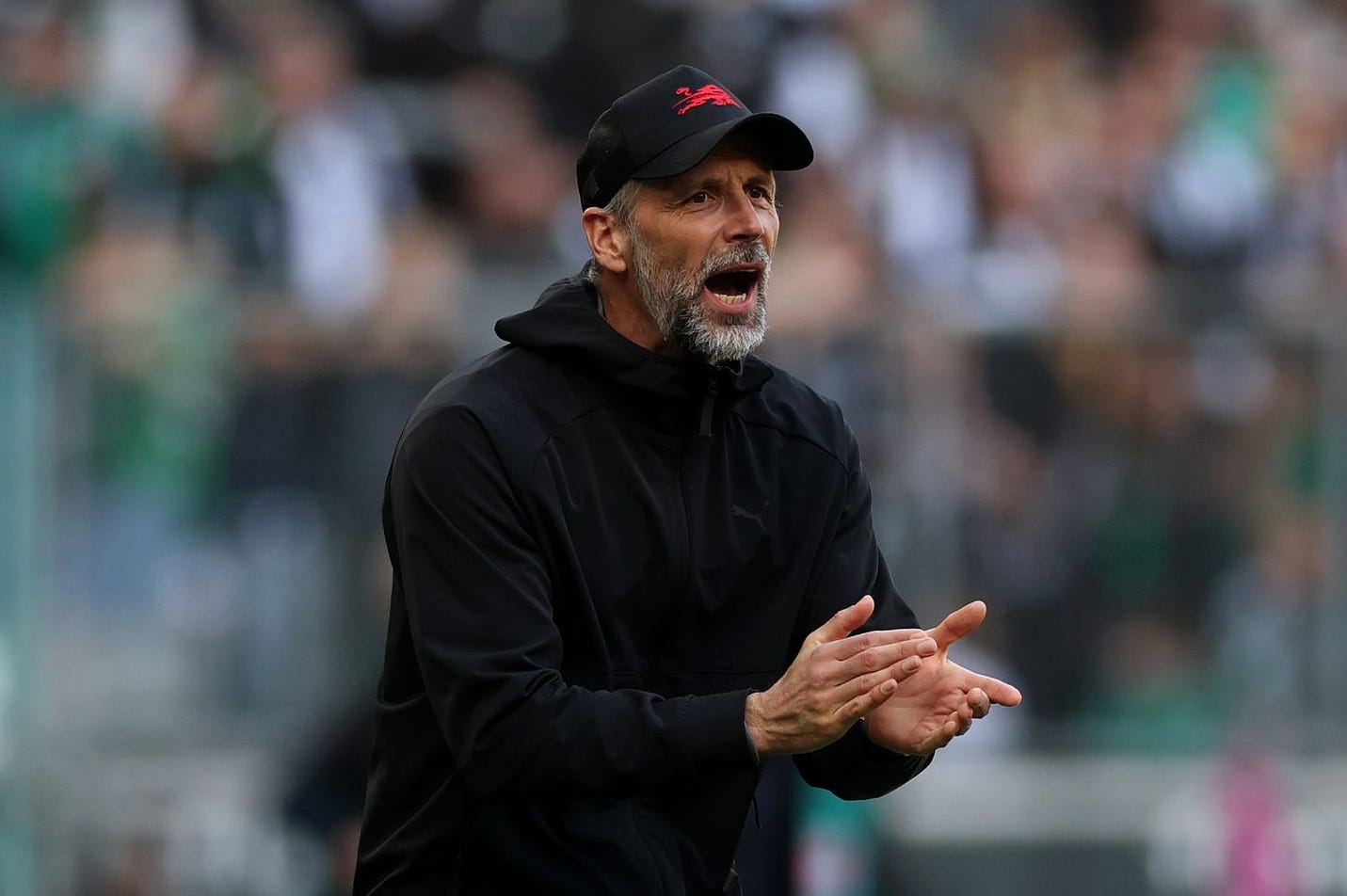

Alright, reader.
After last week’s deep dive into what Andoni Iraola will bring to Liverpool and what his arrival means for our FPL endeavours, it only makes sense to follow up with Bournemouth, who are preparing for the era under Marco Rose.
The German’s managerial career can be split into two parts.
The great one.
And the other… well, you’ll see in a bit.
I won’t discuss his earlier years too much, but so you know the lore, here are a few bullet points:
Rose put himself on the football map as Salzburg manager during the 17/18 and 18/19 seasons, when he won everything in Austria…
… and made a deep run in the Europa League, beating Real Sociedad, Borussia Dortmund, and Lazio before losing to Olympique Marseille in the semi-finals
He then spent two seasons at Borussia Mönchengladbach, guiding them into the Champions League. After finishing 2nd in a group with Real Madrid, Inter Milan, and Shakhtar Donetsk, the draw wasn’t meant to get any easier – they played Manchester City in the first knockout round and were eliminated
After that, he managed Borussia Dortmund. The spell lasted exactly one season, and they finished 2nd in the Bundesliga (the Haaland & Bellingham era)
The following season, Rose became head coach at RB Leipzig, where the fun began…
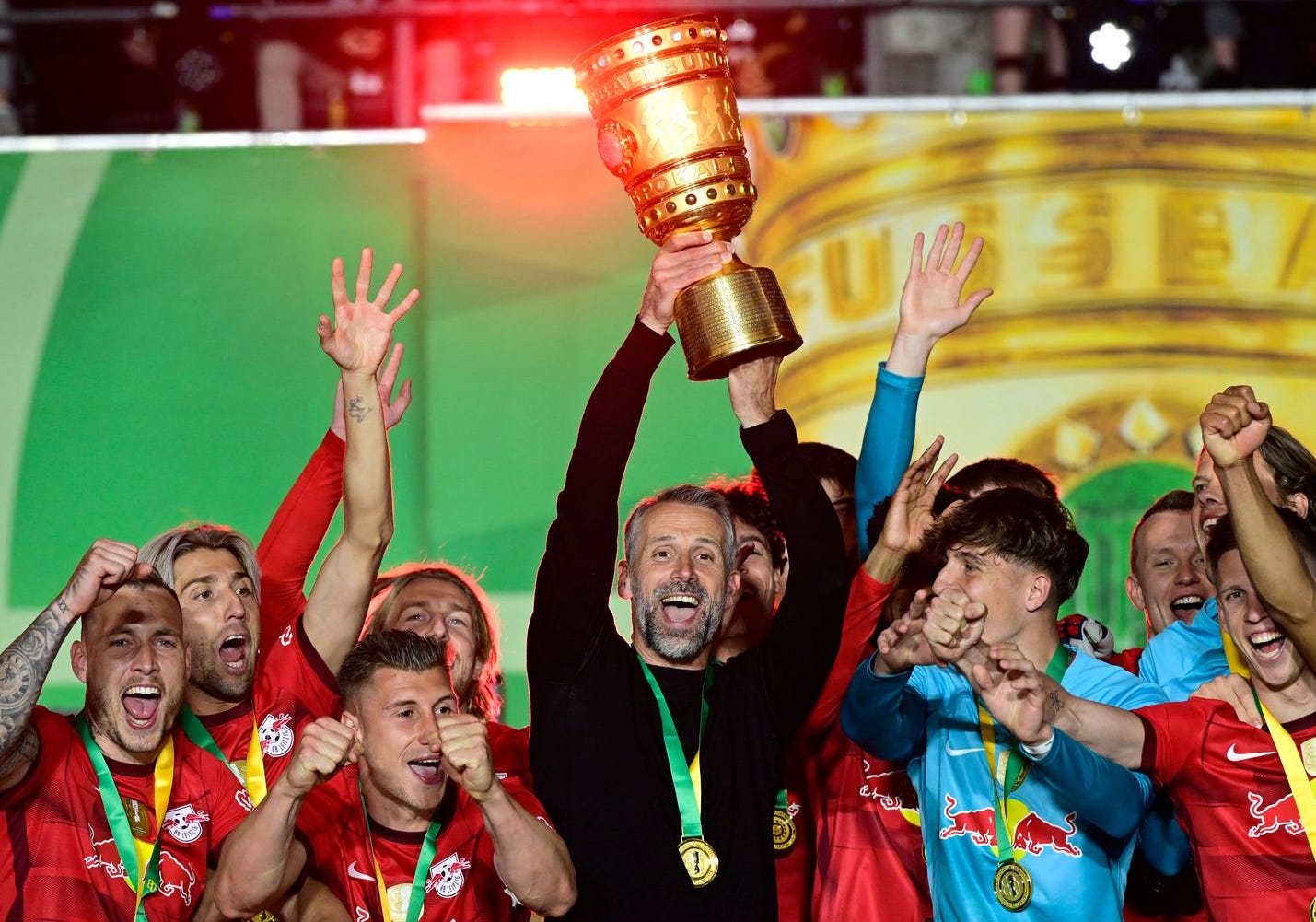
Marco Rose at his managerial peak
Alright, spoiler alert.
RB were very competitive during Rose’s debut season:
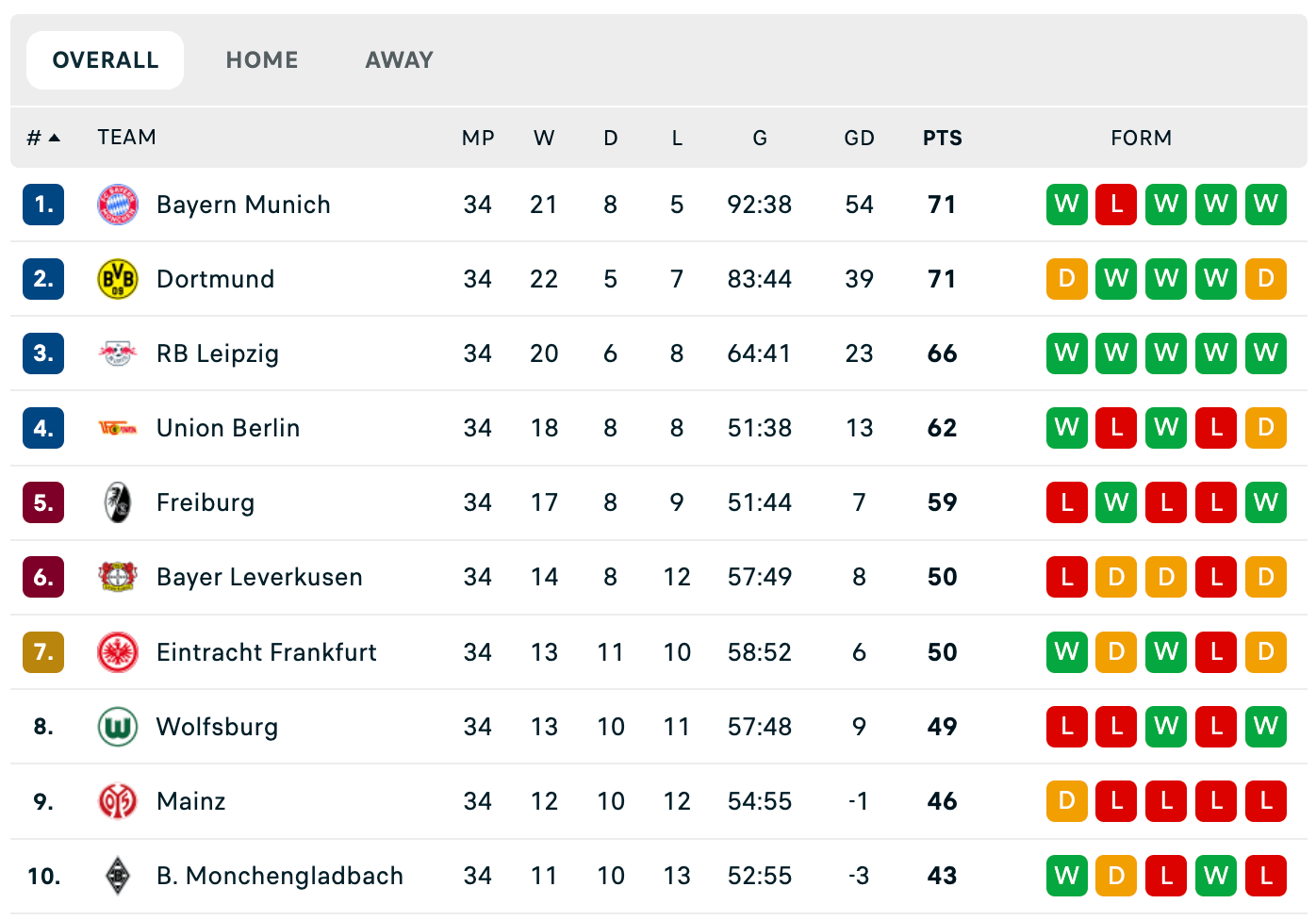
And let me tell you, Rose making life tough for both Bayern and Borussia was simply because his team played fantastic football.
With fantastic players.
When you look at the starting eleven that beat Bayern in the penultimate Bundesliga gameweek, it included Joško Gvardiol, Dominik Szoboszlai, Dani Olmo, Konrad Laimer, Christopher Nkunku, and Amadour Haïdara.
Over those 29 league games with Rose at the helm, RB were tied for the best expected points (xPoints) with Bayern, largely due to dominant defensive performances: they conceded both the fewest non-penalty xG and the fewest actual non-penalty goals.
Their core principle was to congest the pitch centrally, and to keep short distances between players to recover the ball quickly, and make it extremely difficult for opponents to progress through those valuable areas.
💡 Another key part of this was intense counter-pressing: in other words, Leipzig’s high defensive line was instructed to win the ball back immediately after losing it high up the pitch.
The purpose of the press was to force the ball wide and then apply pressure on the receiving player. It was a nightmare not only for opponents who tried to attack slowly, but also for counter-attacking sides, because even if they bypassed the initial press, other Red Bull players were close enough to stop the break.
As a result, Leipzig conceded very few dangerous shots.
1️⃣ Against slow attacks, their defence was on a par with Xabi Alonso’s Leverkusen.
2️⃣ They conceded just two goals from counters, the fewest that season.
3️⃣ And when someone tried to re-press them, it was a battle they couldn’t win, as they simply couldn’t get good chances in the box even when they won the ball – Leipzig conceded just one goal from counter-press.
Hold that thought, because we’ll come back to it.
In the final third of the pitch, Red Bull’s system was built on direct forward play and fast transitions within a narrow, attacking 4-2-2-2 formation.
Whereas both Bayern and Borussia scored 40+ goals over the season from slow, positional attacks, RB scored only about half that number, but breaks and gegen-pressing made up for it: no other team produced as many dangerous shots from such situations.
Their 0.15 xG per shot from breaks is clear evidence of that.
However, the decline began as early as the 23/24 season.
The downfall
You could put some of the blame on the loss of several key players – the lure of the Premier League and Bayern is hard to resist, so RB said goodbye to Gvardiol, Szoboszlai, Nkunku and Laimer.
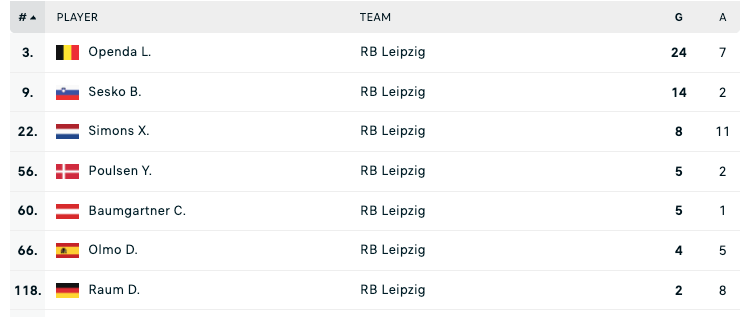
At the same time, Luis Openda and Benjamin Šeško combined for a whopping 38 goals, and Xavi Simons had one of the best seasons of his career.
Still, something was brewing beneath the surface, and it was meant to eventually blow.
It was the Bundesliga campaign that saw Xabi Alonso pull off a title-winning unbeaten run, and Marco Rose (and Red Bull) suddenly stopped being among the hottest topics.
There were still things to like about the team: their defence remained firmly among the best, and those fast transitions still worked well, with only Leverkusen scoring more goals from them.
At the same time, they dropped to 4th in xPoints, far from both Bayern and Bayer.
They suddenly looked much less dominant.
They played with the ball less, became even more direct in possession, the pressing intensity dropped significantly, and the counter-press became less effective, which was probably the worst indicator of all. The share of their possessions when they won the ball high up the pitch shortly after losing it dropped by almost 20%.