


Liverpool are fresh off a weird season marked by a series of bizarre events, injuries, a fair share of bad luck, and some poor performances that ultimately led to the sacking of Arne Slot, who departed just one season after the title-winning campaign.
The general consensus among those who tried to pinpoint exactly what went wrong with the Reds is that they were too passive and too scared out of possession.
Although this was partly true, it’s also been blown out of proportion, as the data don’t exactly support that claim. They were still pretty intense and created a lot of good shots from fast transitions and high turnovers – yes, it wasn’t an elite result, but they were strong in those areas.
I guess it wasn’t enough, and the fact that performance can be heavily affected by things that are simply out of your control wasn’t too sexy a storyline.
Anyway, Liverpool will now get a fair share of intensity from Andoni Iraola. That’s for sure.
Intensity, pressing, and re-pressing are likely the three most frequently mentioned words when discussing his philosophy.
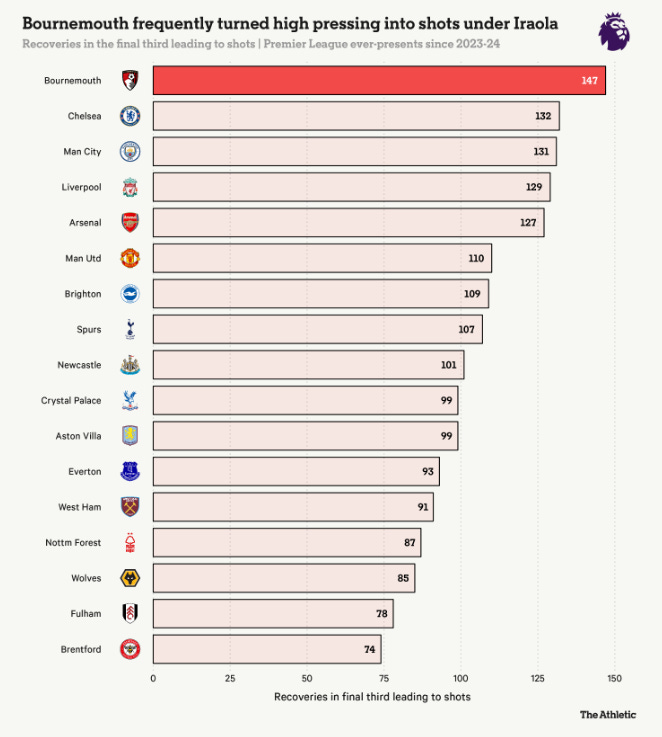
Later in the article, we’ll discuss a lot of specific data, but to set the tone, let’s look at the metric that perfectly illustrates Iraola’s approach.
You might come across different versions of it online, but this one is from The Athletic and shows how many shots Bournemouth produced shortly after winning the ball in the final third of the pitch since the 2023/2024 season:
But first things first – let’s talk about defence…
Iraola can control his chaos
Last season showed that Iraola isn’t just some madman who demands his players be relentless all the time, but can adapt to new orders.
I do feel this tends to be overlooked.
Bournemouth entered the previous season without Dean Huijsen, Milos Kerkez, and Illia Zabarnyi. Kerkez and Zabarnyi were two of the three most-used players in the 24/25 season, and if you sum the minutes of all three, it’s close to 10,000.
Despite heavy personnel changes, a commitment to an attacking philosophy, or Djordje Petrovič going through a poor run of shot-stopping for a substantial part of the season – before returning to his Strasbourg level towards the end – they produced some intriguing defensive numbers.
While they played a high defensive line (on a par with Liverpool) and applied the most intense press in the Premier League in 24/25, there was an evident effort to stabilise and allow the team to adapt to new players.
They dropped to a mid-block last season and, at times, stepped off the gas in pressing intensity, while still remaining among the fiercest teams in the final third.
💡 They finished in the bottom half for total xG conceded last season, but that table was pretty crowded – the difference between 10th and 19th was just 6 xG, and the gap between the top 5 and 19th was about 10 xG.
Even though Iraola’s approach is to create chaos, it’s certainly not chaos without rules.
Along with a lower defensive block than usual, there was a compact structure that allowed them to win loose balls often and avoid being too exposed when losing the ball in their defensive half, a common flaw among many attacking teams.
And it showed in the data:
They had the lowest xG conceded per game (0.40) and xG conceded per shot (0.09) when defending in a low block against slow, sustained attacks
They were especially sound in home games, where they conceded just 4 non-penalty goals throughout the season with avg. 0.80 xG conceded, similar to Arsenal