

There’s a good chance that by the time you're reading this, you already know how the EFL Cup semi-finals panned out, and which teams will double in Gameweek 26 (and blank in Gameweek 31).
Regardless of which version of Double Gameweek 26 happens, you’ll get plenty of insight into players, teams, match-up specifics, and other details that will come in handy even outside DGW.
It will help you when playing FPL, betting, creating your own articles, or just telling your mates in the pub. I definitely recommend that you read the whole article.
The most likely scenario is Arsenal and Wolves forming the following DGW26:
Arsenal: Brentford (A), Wolves (A)
Wolves: Forest (A), Arsenal (H)
So, I’ll start with that.
After that, I’ll discuss the alternative:
Chelsea: Leeds (H), Everton (A)
Everton: Bournemouth (H), Chelsea (A)
Gabriel (£7.0m)
To get a complete picture, we need to talk about Arsenal as a whole for a moment.
They remain the favourites to win the title.
Depending on the specific data model, their title chances range from 70% to 90%—one of the most optimistic predictions comes from OPTA, which has them at 91.4% at the time of writing.
They lead the expected points (xPoints) table by 8 points, with Liverpool and Manchester City as their closest rivals. That metric is straightforward: it evaluates the quality of chances created and conceded, then calculates the likelihood of winning, losing or drawing based on that.
One might say their performances are mainly driven by defence, but although their defence is truly world-class, it doesn’t mean they don’t create plenty of good chances (as the Leeds game showed).
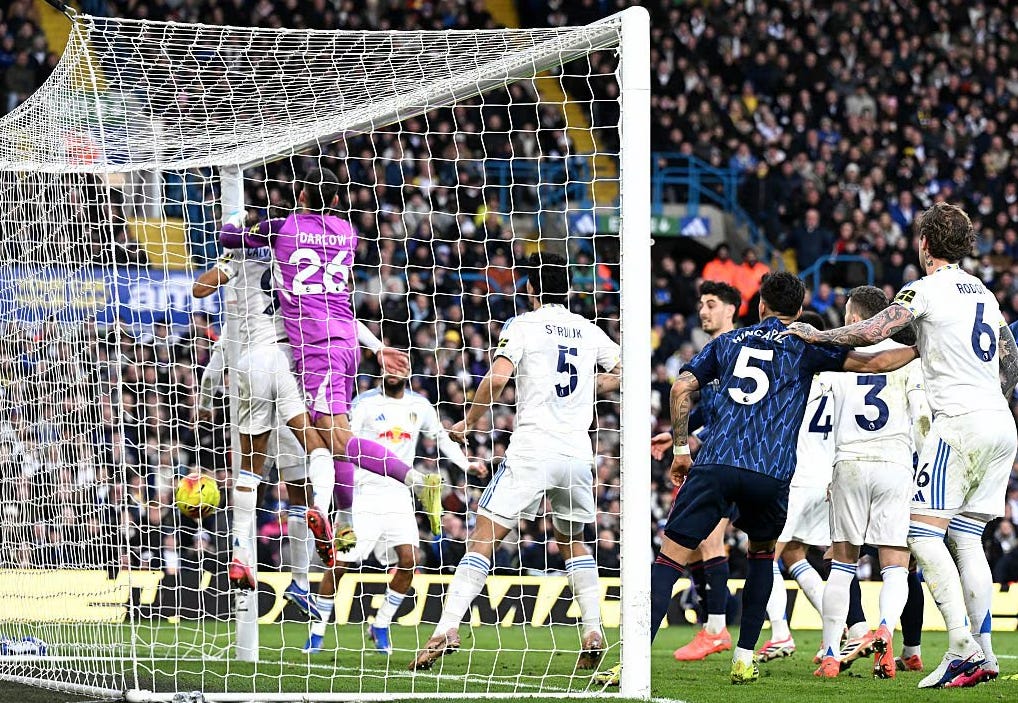
They are the second-best Premier League attack behind City, but only about 1 expected goal separates the two teams.
While it’s true that they create 32% of their xG from set-pieces, and four other teams created more expected goals from open play, the sheer volume of chances is huge, and that’s what matters.
Let’s add that no other team created more expected and actual goals from set plays.
🏅 Then there’s the cherry on the cake: So far, they’ve allowed just 16.50 xG and conceded 17 goals (as per StatsBomb data via FantasyFootballScout).
The second-best defences are Liverpool and Manchester City, who have conceded 27 xG. The funny stat is that while City have conceded 23 actual goals, Liverpool are on… I can hear all the oh, ffs’ from Virgil van Dijk owners… 33 goals.
Anyway, several lessons from that:
Arsenal’s triple-up is non-negotiable for the potential Double Gameweek 26 (duh)
Arsenal’s triple-up is a good play outside DGWs (obv)
Arsenal’s defensive double-up (at least) is advisable for the rest of the season
No one can argue with you if you opt for a defensive triple-up: a combination of defensive quality, set-piece prowess, and plenty of good midfield options to choose from now
And then there’s the most obvious statement in the article: Gabriel Magalhães is Arsenal’s best pick.
Bear with me. There will be much more niche analysis as we move forward.
When he starts, he usually plays the whole game—he was taken off early only once in 17 starts.
Plus, he’s absolutely essential during corner and free-kick routines. He’s tied for first among Arsenal players for the number of attempts from corners, even though he missed six games in November and December.
In total, he has 15 shots with 2.40 xG and 3 goals, plus two assists.
Half of those attempts came after he returned from the sidelines in Gameweek 18, so there are now signs of slowing down.
Also, 8.71 defensive contributions per 90 minutes and a 33% completion rate are not too shabby given the quality of the defence he’s part of…
With Saka possibly injured or his minutes limited, he might now be the main captaincy option, even a triple captaincy for some.
Jurriën Timber (£6.3m)
If you’re a glass-half-full type of manager, you see all those positive signs—good shots, aerial threat, creativity, and activity in the final third.
Since December, he’s racked up almost 2 expected goals, and although he’s missed all of them, the most important thing is that he’s regularly in those areas. About half of them were from the corner, and the rest from open play.
There’s also solid assist potential, so he’s a nice type of player to own during a double gameweek.
He gets the ball into the box 2.70 times per game, whether with a pass, a cross, a run, or a dribble, and has about the same volume of touches inside that area. That number of entries might not seem like much, but when you realise Declan Rice is on 3.1 per game… yeah, it’s a lot.
It feels like there’s a haul just around the corner.